The short answer
Retrieval practice is the act of pulling something you've learned back out of memory, without your notes in front of you. Every time pupils retrieve something, they make it easier to remember next time, so the recall itself is part of the learning. In the classroom it usually means short, low-stakes quizzes, brain dumps and questions on earlier topics.
What does retrieval practice look like in the classroom?
It looks like pupils doing the remembering, little and often. A five question starter on last week's topic, a blank page brain dump, a set of flashcards, a closed-book attempt at a diagram they then check against the textbook. Nothing has to be marked and nothing has to count.
The common thread is that the notes are closed while pupils try to remember, and then they check. That check is important, because it's where pupils find out what they actually know rather than what they feel they know.
It can be as simple as asking a class to write down three things they remember from last lesson before you start. It's quick, it costs nothing and everyone can do it.
Why does retrieval practice work?
Remembering is effortful, and that effort strengthens the memory. When pupils re-read their notes, the page feels familiar and they feel like they know it. When they have to bring it back from memory, they find out whether they really do, and the act of recall makes the knowledge easier to find next time.
Robert Bjork called this kind of effort a desirable difficulty. The conditions that make learning feel slow and hard in the moment, like spacing it out, mixing it up and testing instead of reviewing, are often the ones that make it last. Re-reading and cramming feel smooth and productive, but they mostly produce confidence without retention.
Forgetting is part of this too. A bit of forgetting between practice attempts makes the next retrieval harder, and that harder retrieval does more for long-term memory. So the strategies that feel least efficient in the lesson are often the ones doing the most helpful work, and it's worth not discounting them.
What does the research say about retrieval practice?
Retrieval practice is one of the best supported findings in the learning sciences. Roediger and Karpicke (2006) found that students who were tested on material remembered far more of it a week later than students who spent the same time restudying it, and Dunlosky and colleagues (2013) rated practice testing as one of the two most useful learning techniques.
Karpicke and Blunt (2011) went further and compared retrieval with concept mapping while looking at the text. Retrieval came out ahead, and it even helped students produce better concept maps later on. Dunlosky's review put re-reading and highlighting among the least effective techniques, which is worth knowing, because they're what most pupils do when they revise.
It's also fair to say where the evidence thins. The Education Endowment Foundation's 2021 review of cognitive science in the classroom is supportive of retrieval and spacing, and honest that there's more laboratory evidence than classroom evidence. That's a good reason to try it deliberately and look at what happens with your own pupils.
Where this research comes from
- The testing effect: Roediger and Karpicke
- Desirable difficulties: Robert and Elizabeth Bjork
- Which study techniques work best: Dunlosky and colleagues
- Retrieval in real classrooms: Pooja Agarwal
- Spacing and the forgetting curve: Cepeda, building on Ebbinghaus
How often should you do retrieval practice?
Little and often, and spread out over time. A few minutes in most lessons works better than one long revision session, and coming back to older topics after days, weeks and months does more than practising the same thing again straight away.
This is where retrieval practice meets spaced practice. A simple way in is a starter with one question from last lesson, one from last week and one from last month. It builds spacing into your routine without you needing to track it all on a spreadsheet.
Mixing topics up helps as well. When questions on different topics are interleaved, pupils have to work out which idea or method each question needs, and that choice is part of what they'll have to do in an exam.
What are the best retrieval practice activities?
The best activities are the ones that make every pupil do the remembering, with the notes closed, and then check. Low-stakes quizzes, brain dumps, closed-book reconstruction, cued recall, concept maps from memory and pupils teaching each other all do this well.
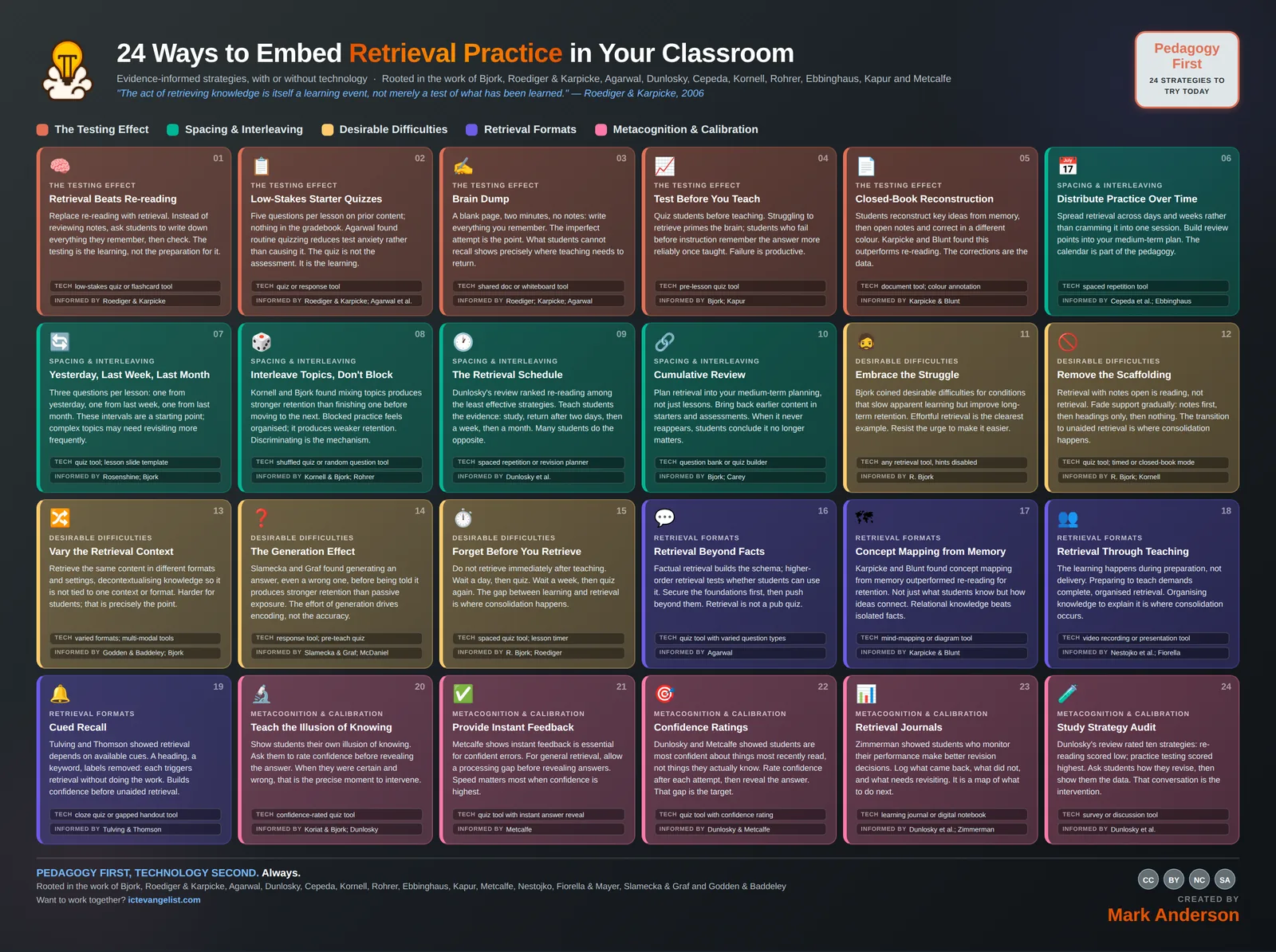
In the guide I've grouped 24 strategies into five families: the testing effect, spacing and interleaving, desirable difficulties, retrieval formats, and metacognition and calibration. The full list is further down this page, and each one has its own page with an example, a way to begin and what to look out for.
If you're starting from scratch, pick one. A low-stakes starter quiz or a brain dump is a really good first step, because both are quick to set up and easy to keep going.
What are the common mistakes with retrieval practice?
The common mistakes are making it high stakes, letting pupils look at their notes, giving answers away too quickly, and only ever asking about last lesson. Each one takes away the effort that makes retrieval work.
Marks and league tables raise anxiety and push pupils towards guessing or copying, so keep it low stakes. Hints and multiple choice options can make it too easy, because recognising an answer is easier than recalling it. And if every quiz is about yesterday, you lose the benefit of spacing.
The other common one is skipping the check. Pupils need to see what they got right and wrong, and correct it, or the gaps stay hidden.
How can technology and AI help with retrieval practice?
Technology helps most when it makes regular recall simple to run, without doing the thinking for pupils. Quiz tools can take the marking away, and spaced repetition tools can bring older material back at the right time automatically. AI can help you write question sets quickly, as long as you check them.
Retrieval is not a game show, though. If a tool rewards the fastest finger, gives the answer away too quickly or turns it all into points and streaks, it removes the desirable difficulty that makes the practice worthwhile. Use technology to help manage the activity, but never the struggle for learners.
With AI, the same rule applies to the questions it writes for you. Check its work, like every child in your classroom. And sometimes a mini whiteboard beats anything that needs Wi-Fi and a battery.
How do I start retrieval practice tomorrow?
Start your next lesson with three questions: one from last lesson, one from last week and one from last month. Pupils answer from memory, then you go through the answers together and they correct their own. It takes about five minutes and needs nothing but paper.
Keep it going for a few weeks before you judge it. It'll feel a bit harder for pupils at first, and that's normal. Then look at what's happening: which topics keep coming back wrong, and whether pupils are getting better at remembering the older material.
From the guide
All 24 retrieval practice strategies
Each one has its own page, with why you might use it, an example and a way to begin. You'll find them all, with the infographic, in 01 Retrieval Practice.
The Testing Effect
- Retrieval Beats Re-reading Replace re-reading with retrieval. Instead of reviewing notes, ask students to write down everything they remember, then check. The testing is the learning, not the preparation for it. 01 Retrieval Practice · The Testing Effect
- Low-Stakes Starter Quizzes Five questions per lesson on prior content; nothing in the gradebook. Agarwal found routine quizzing reduces test anxiety rather than causing it. The quiz is not the assessment. It is the learning. 01 Retrieval Practice · The Testing Effect
- Brain Dump A blank page, two minutes, no notes: write everything you remember. The imperfect attempt is the point. What students cannot recall shows precisely where teaching needs to return. 01 Retrieval Practice · The Testing Effect
- Test Before You Teach Quiz students before teaching. Struggling to retrieve primes the brain; students who fail before instruction remember the answer more reliably once taught. Failure is productive. 01 Retrieval Practice · The Testing Effect
- Closed-Book Reconstruction Students reconstruct key ideas from memory, then open notes and correct in a different colour. Karpicke and Blunt found this outperforms re-reading. The corrections are the data. 01 Retrieval Practice · The Testing Effect
Spacing & Interleaving
- Distribute Practice Over Time Spread retrieval across days and weeks rather than cramming it into one session. Build review points into your medium-term plan. The calendar is part of the pedagogy. 01 Retrieval Practice · Spacing & Interleaving
- Yesterday, Last Week, Last Month Three questions per lesson: one from yesterday, one from last week, one from last month. These intervals are a starting point; complex topics may need revisiting more frequently. 01 Retrieval Practice · Spacing & Interleaving
- Interleave Topics, Don't Block Kornell and Bjork found mixing topics produces stronger retention than finishing one before moving to the next. Blocked practice feels organised; it produces weaker retention. Discriminating is the mechanism. 01 Retrieval Practice · Spacing & Interleaving
- The Retrieval Schedule Dunlosky's review ranked re-reading among the least effective strategies. Teach students the evidence: study, return after two days, then a week, then a month. Many students do the opposite. 01 Retrieval Practice · Spacing & Interleaving
- Cumulative Review Plan retrieval into your medium-term planning, not just lessons. Bring back earlier content in starters and assessments. When it never reappears, students conclude it no longer matters. 01 Retrieval Practice · Spacing & Interleaving
Desirable Difficulties
- Embrace the Struggle Bjork coined desirable difficulties for conditions that slow apparent learning but improve long-term retention. Effortful retrieval is the clearest example. Resist the urge to make it easier. 01 Retrieval Practice · Desirable Difficulties
- Remove the Scaffolding Retrieval with notes open is reading, not retrieval. Fade support gradually: notes first, then headings only, then nothing. The transition to unaided retrieval is where consolidation happens. 01 Retrieval Practice · Desirable Difficulties
- Vary the Retrieval Context Retrieve the same content in different formats and settings, decontextualising knowledge so it is not tied to one context or format. Harder for students; that is precisely the point. 01 Retrieval Practice · Desirable Difficulties
- The Generation Effect Slamecka and Graf found generating an answer, even a wrong one, before being told it produces stronger retention than passive exposure. The effort of generation drives encoding, not the accuracy. 01 Retrieval Practice · Desirable Difficulties
- Forget Before You Retrieve Do not retrieve immediately after teaching. Wait a day, then quiz. Wait a week, then quiz again. The gap between learning and retrieval is where consolidation happens. 01 Retrieval Practice · Desirable Difficulties
Retrieval Formats
- Retrieval Beyond Facts Factual retrieval builds the schema; higher-order retrieval tests whether students can use it. Secure the foundations first, then push beyond them. Retrieval is not a pub quiz. 01 Retrieval Practice · Retrieval Formats
- Concept Mapping from Memory Karpicke and Blunt found concept mapping from memory outperformed re-reading for retention. Not just what students know but how ideas connect. Relational knowledge beats isolated facts. 01 Retrieval Practice · Retrieval Formats
- Retrieval Through Teaching The learning happens during preparation, not delivery. Preparing to teach demands complete, organised retrieval. Organising knowledge to explain it is where consolidation occurs. 01 Retrieval Practice · Retrieval Formats
- Cued Recall Tulving and Thomson showed retrieval depends on available cues. A heading, a keyword, labels removed: each triggers retrieval without doing the work. Builds confidence before unaided retrieval. 01 Retrieval Practice · Retrieval Formats
Metacognition & Calibration
- Teach the Illusion of Knowing Show students their own illusion of knowing. Ask them to rate confidence before revealing the answer. When they were certain and wrong, that is the precise moment to intervene. 01 Retrieval Practice · Metacognition & Calibration
- Provide Instant Feedback Metcalfe shows instant feedback is essential for confident errors. For general retrieval, allow a processing gap before revealing answers. Speed matters most when confidence is highest. 01 Retrieval Practice · Metacognition & Calibration
- Confidence Ratings Dunlosky and Metcalfe showed students are most confident about things most recently read, not things they actually know. Rate confidence after each attempt, then reveal the answer. That gap is the target. 01 Retrieval Practice · Metacognition & Calibration
- Retrieval Journals Zimmerman showed students who monitor their performance make better revision decisions. Log what came back, what did not, and what needs revisiting. It is a map of what to do next. 01 Retrieval Practice · Metacognition & Calibration
- Study Strategy Audit Dunlosky's review rated ten strategies: re-reading scored low; practice testing scored highest. Ask students how they revise, then show them the data. That conversation is the intervention. 01 Retrieval Practice · Metacognition & Calibration
Quick questions
Retrieval practice: quick questions
Is retrieval practice the same as testing?
Not quite. A test usually measures what pupils know and often counts for something. Retrieval practice uses the act of remembering as a way to learn, so it works best when it's low stakes, frequent and doesn't count towards a grade.
What is the difference between retrieval practice and spaced practice?
Retrieval practice is about how pupils study: by recalling from memory. Spaced practice is about when: spreading study out over time. They work best together, with regular retrieval of older material spread across weeks and months.
Does retrieval practice work in primary schools?
Yes. Studies have found benefits across a wide range of ages, from young children to university students. With younger pupils, keep it short, oral or visual where that helps, and make the checking part of the routine.
Should retrieval practice be marked?
It doesn't need to be. Pupils can check their own answers against the correct ones, which is quicker for you and helps them see their own gaps. Keep scores private so it stays low stakes.
How long should a retrieval practice starter take?
Around five minutes is plenty. Three to five questions, answered from memory, then checked together. Short enough to do most lessons, long enough for every pupil to have a proper go.
Is multiple choice good for retrieval practice?
It can help, but recognising the right answer is easier than recalling it. Use multiple choice with plausible wrong answers, and mix it with questions where pupils have to produce the answer themselves.
Further reading and evidence
Where this thinking comes from
The wider evidence around this area, kept deliberately short. No single study validates all 24 strategies; these are the traditions the thinking comes from, and good places to read further. How this site uses evidence.
- Roediger & Karpicke (2006), Test-Enhanced Learning, Psychological Science. The modern starting point for the testing effect: retrieving beats restudying.
- Dunlosky, Rawson, Marsh, Nathan & Willingham (2013), Improving Students’ Learning With Effective Learning Techniques, PSPI. The review that ranked practice testing and distributed practice highest, and re-reading among the least effective.
- Karpicke & Blunt (2011), Retrieval Practice Produces More Learning than Elaborative Studying, Science. Retrieval outperformed concept mapping from the text, and even improved later concept mapping.
- Agarwal & Bain, retrievalpractice.org. Free, practical guides translating the research for classrooms.
- EEF (2021), Cognitive Science Approaches in the Classroom. Supportive on retrieval and spacing, and honest that classroom evidence is thinner than laboratory evidence.
More teacher's guides
The other guides, and the model behind them
Want to take this further?
Support is available
If you're a leader wanting help to turn this into professional learning across your school or trust, that's exactly the work I do.