Chapter Six of six

Metacognition & Self-Regulation

Students who can orchestrate their own thinking processes consistently outperform those who cannot. This chapter explores how to cultivate that ability explicitly, ensuring self-regulation is a taught skill rather than a fortunate byproduct. It involves empowering learners to dissect the challenge, select the right cognitive tools, evaluate their ongoing progress, and pivot effectively when obstacles arise.

Rooted in the work of Zimmerman, Flavell, Winne, Butler, and Willingham

As children should learn about metacognition and how best to learn, they should also be taught how to use technology to support their learning.

Anderson & Lewis, The EdTech Playbook, 2025

24 strategies5 groupsabout 24 minutes to read

The original

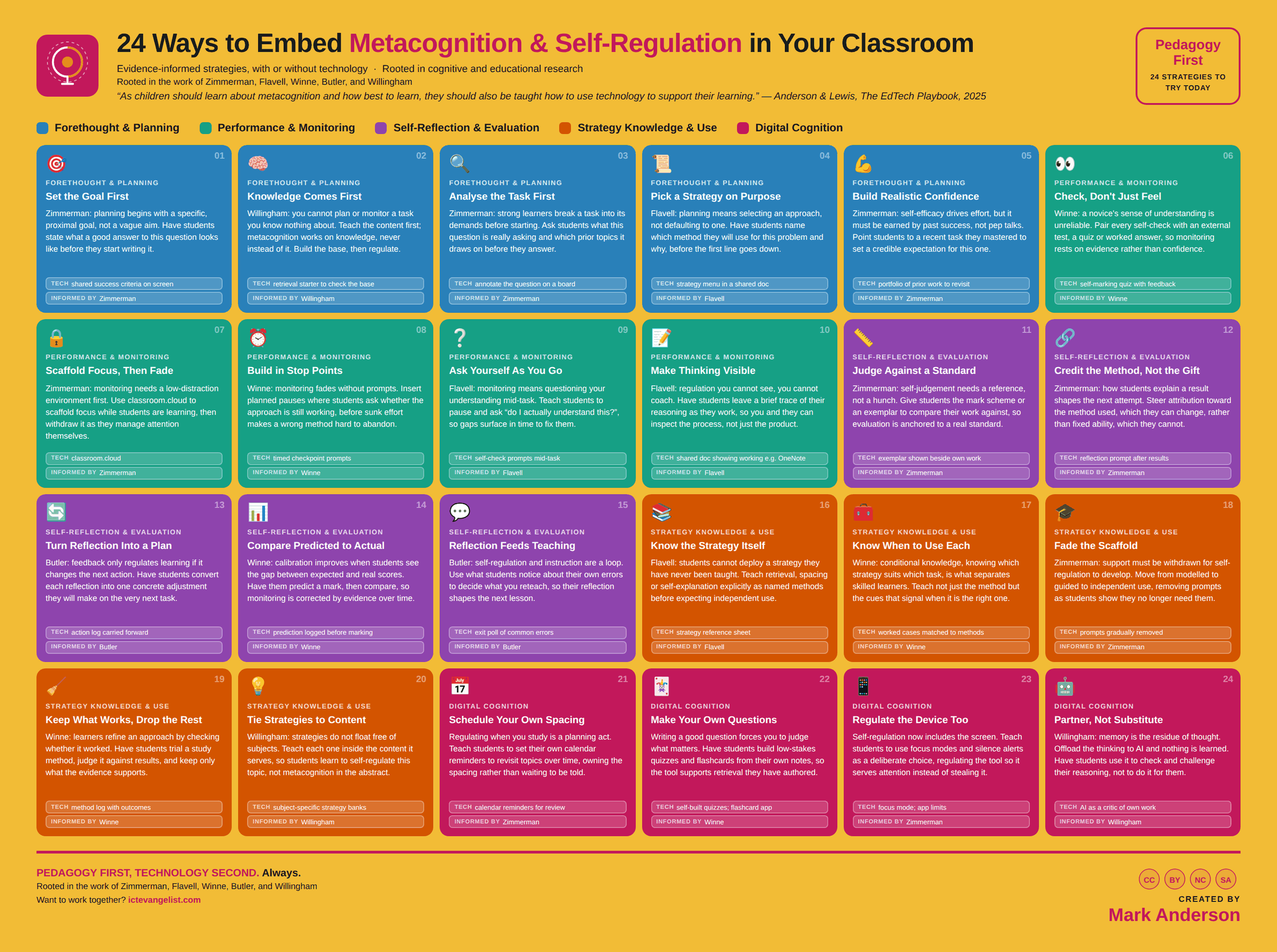
The infographic this chapter expands

The Metacognition & Self-Regulation infographic: 24 strategies laid out in colour coded groups, each with a title, a short description, a suggested technology and the researchers behind it. Every strategy is written out in full further down this page.
All 24 on one page. Download the full size image for printing or sharing, or read every strategy expanded below.

The thinking

Why these strategies

Self-regulation is not something pupils simply pick up by being told to reflect. It has to be taught, modelled, practised and gradually handed over.

Zimmerman’s work showed us that self-regulation is a cycle, not a fixed trait. Learners look ahead, choose a strategy, monitor how it is going, then use what they notice to improve the next attempt. Flavell’s work gave us the language of metacognition, helping us see that pupils can become more aware of their own thinking. Winne took this further by showing how learners should monitor and adjust while the work is happening, not just after it is finished.

This is where technology can help, when it is used intentionally (and that’s the point). Digital tools can help pupils plan, track, reflect and improve. Used poorly, students can offload their thinking, weakening the very capacity we are trying to build.

Reflection only earns the name metacognition when it changes what the learner does next.
In practice

Where technology serves

Technology can scaffold self-regulation, or it can quietly do the regulating for the student.

Learning journals, planning tools and progress dashboards can make invisible thinking visible, prompting students to set goals, check progress and adjust, which is the Zimmerman cycle made concrete. Used deliberately, these supports are scaffolds: present while the habit forms, then faded as the learner takes over.

The risk is a tool that monitors and corrects so smoothly that the student never has to, removing the very work that builds the capacity. A guide that hands you the answer makes you dependent on the guide.

Scaffold the regulation, then fade the scaffold. The goal is a learner who no longer needs the tool.

Knowing whether it worked

How would you know?

The size of the gap between predicted and actual marks.

Calibration is the most measurable thing in this chapter. Have students predict a mark before every assessment and log both. A narrowing gap over a term is real evidence that self-monitoring is improving, and it's a better indicator than any self-report questionnaire about how reflective students feel.

Forethought & Planning

5 strategies
01

Set the Goal First

Zimmerman: planning begins with a specific, proximal goal, not a vague aim. Have students state what a good answer to this question looks like before they start writing it.

Planning starts with a specific, close-at-hand goal rather than a general aim. Not do well in this essay, but this paragraph will make one claim and support it with two pieces of evidence.

Why it works

Zimmerman's forethought phase begins with goal setting, and his research distinguishes proximal goals, which are specific and near, from distal ones, which are general and remote. Proximal goals give the learner something to monitor against during the task. A vague aim gives them nothing to check, so monitoring doesn't happen.

How to run it

  1. Before students start, ask them to write what a good answer to this question would contain.
  2. Insist on specifics rather than adjectives. Detailed is not a goal.
  3. Keep the goal visible while they work.
  4. Return to it at the end and ask whether it was met.

Where technology serves

Shared success criteria on screen give everyone the same reference point, and keep it visible for the whole task rather than for the first minute.

Watch for: Goals that are really instructions in disguise don't develop planning. The student has to make the decision for it to be planning.

Techshared success criteria on screenInformed byZimmerman
02

Knowledge Comes First

Willingham: you cannot plan or monitor a task you know nothing about. Teach the content first; metacognition works on knowledge, never instead of it. Build the base, then regulate.

Teach the content before expecting students to regulate their learning of it. Metacognition works on knowledge; it doesn't substitute for it.

Why it works

Willingham's argument is that metacognitive strategies are largely domain-general while the ability to use them well isn't. You can't judge whether your understanding of a topic is adequate if you know almost nothing about the topic. Self-regulation applied to an empty schema produces confident students who are monitoring nothing.

How to run it

  1. Establish the knowledge base before introducing the strategy.
  2. Check the base is secure with retrieval, not with self-report.
  3. Teach the strategy inside the content rather than in a separate session.
  4. Expect strategy use to be weaker in unfamiliar topics, and reteach it there.

Where technology serves

A retrieval starter checks the base is actually present before you build regulation on top of it.

Watch for: Generic study skills lessons detached from subject content are the classic version of this error, and they transfer poorly.

Techretrieval starter to check the baseInformed byWillingham

Zimmerman: strong learners break a task into its demands before starting. Ask students what this question is really asking and which prior topics it draws on before they answer.

Before starting, break the task down: what is it actually asking, what does it require, which prior learning does it draw on?

Why it works

Zimmerman's research on self-regulated learners found that task analysis distinguishes strong performers from weak ones at the outset. Weak performers begin writing; strong performers spend the first minute working out what the question wants. The difference in output is largely decided before either has written a sentence.

How to run it

  1. Give a minute of analysis time before any work begins.
  2. Ask three questions: what is it asking, what will a good answer contain, what do I already know?
  3. Annotate the question itself rather than doing it mentally.
  4. Share a few analyses so students see how others read the question.

Where technology serves

Annotating the question on a shared board makes the analysis visible and collective, which is how students learn what a good analysis looks like.

Watch for: Task analysis that becomes a worksheet to complete stops being thinking and becomes another thing to finish before starting.

Techannotate the question on a boardInformed byZimmerman

Flavell: planning means selecting an approach, not defaulting to one. Have students name which method they will use for this problem and why, before the first line goes down.

Planning means choosing an approach deliberately rather than defaulting to whichever one you used last.

Why it works

Flavell's work on metacognitive knowledge distinguishes knowing strategies from knowing when to use them. Students who have several methods available but never pause to select are functionally operating with one. Requiring the choice to be named, before work begins, makes the selection conscious and therefore improvable.

How to run it

  1. Have students name the method they'll use and why, before they start.
  2. Keep a visible menu of the methods you've taught for this kind of problem.
  3. Ask two students who chose differently to explain their reasoning.
  4. Return at the end: was that the right choice?

Where technology serves

A strategy menu in a shared document, built up across a unit, gives students something to choose from rather than something to recall.

Watch for: If only one method has been taught properly, the choice is theatre. Build the repertoire before asking for selection.

Techstrategy menu in a shared docInformed byFlavell

Zimmerman: self-efficacy drives effort, but it must be earned by past success, not pep talks. Point students to a recent task they mastered to set a credible expectation for this one.

Build confidence on evidence of past success rather than on encouragement.

Why it works

Zimmerman's work identifies self-efficacy as a driver of effort and persistence, and mastery experience as its most reliable source. Encouragement without evidence is unpersuasive to the student who has just failed twice. Pointing to a specific task they recently mastered gives them a concrete reason to expect they can do this one.

How to run it

  1. Before a hard task, point to a comparable one they succeeded at.
  2. Be specific: three weeks ago you did this, and this is the same structure.
  3. Keep work accessible so past success can be revisited, not just remembered.
  4. Avoid general reassurance. You can do this is not evidence.

Where technology serves

A portfolio of prior work makes past success visible and revisitable, which is what turns it into evidence rather than a claim.

Watch for: Confidence built on tasks that were made easy collapses on contact with a real one, and the collapse costs more than the confidence gained.

Techportfolio of prior work to revisitInformed byZimmerman

Performance & Monitoring

5 strategies

Winne: a novice's sense of understanding is unreliable. Pair every self-check with an external test, a quiz or worked answer, so monitoring rests on evidence rather than confidence.

Why it works

Winne's work on monitoring found that learners' internal judgements are systematically miscalibrated, particularly for novices, and particularly just after reading something. Fluency feels like knowledge. An external check, a quiz, a worked answer, a peer, converts a feeling into information.

How to run it

  1. After any do you understand moment, follow with a question that tests it.
  2. Make the external check immediate, while the judgement is still fresh.
  3. Show students the gap when it appears, without making it a failure.
  4. Repeat often enough that they start distrusting the feeling themselves.

Where technology serves

A self-marking quiz with feedback gives the external check instantly and privately, which makes students more willing to find out they were wrong.

Watch for: Asking students to rate their own understanding and acting on the ratings alone builds a lesson on unreliable data.

Techself-marking quiz with feedbackInformed byWinne

Zimmerman: monitoring needs a low-distraction environment first. Use classroom.cloud to scaffold focus while students are learning, then withdraw it as they manage attention themselves.

Provide a low-distraction environment while students are learning to monitor their own work, then withdraw the support as they take over.

Why it works

Zimmerman's performance phase includes attention control as a component of self-regulation, and like the other components it's learned rather than innate. Scaffolding the environment first is legitimate; leaving the scaffold permanently isn't, because the student never develops the capacity themselves.

How to run it

  1. Start with the structure: clear expectations, reduced distraction, defined work periods.
  2. Name what you're doing and why, so it's understood as temporary.
  3. Withdraw the external control in stages as students demonstrate they can manage.
  4. Expect regression and reinstate briefly rather than abandoning the fade.

Where technology serves

Classroom management tools can scaffold focus during the learning phase. Treat them as scaffolding to be removed, not as the permanent condition of the room.

Watch for: Monitoring software used indefinitely teaches compliance under observation rather than self-regulation, and students behave accordingly the moment it's off.

Techclassroom.cloudInformed byZimmerman

Winne: monitoring fades without prompts. Insert planned pauses where students ask whether the approach is still working, before sunk effort makes a wrong method hard to abandon.

Why it works

Winne's model treats monitoring as a process that fades without cues, particularly when a task is absorbing. The sunk cost problem is real: the further into a wrong method a student is, the less willing they're to abandon it. A checkpoint at the third minute is considerably cheaper than one at the twentieth.

How to run it

  1. Plan two or three stop points into any extended task.
  2. At each, one question: is this working, and how do I know?
  3. Make changing approach explicitly acceptable at those points.
  4. Ask a couple of students what they changed and why.

Where technology serves

Timed checkpoint prompts on the board remove the need for you to interrupt, which makes the pause feel structural rather than like a correction.

Watch for: Checkpoints that always conclude carry on become ritual. Some students need to be given permission to abandon and restart.

Techtimed checkpoint promptsInformed byWinne

Flavell: monitoring means questioning your understanding mid-task. Teach students to pause and ask β€œdo I actually understand this?”, so gaps surface in time to fix them.

Teach students to interrupt themselves mid-task with a direct question: do I actually understand this, or am I just following along?

Why it works

Flavell's original account of metacognition centres on this kind of monitoring during a cognitive activity. The value is timing. A gap noticed while there's still time to fix it becomes a question to the teacher; the same gap noticed in an exam becomes a lost mark. Students rarely do this unprompted because the prompt has to come from inside.

How to run it

  1. Teach the specific question and the moments to ask it.
  2. Model it aloud yourself while working through an example.
  3. Give a physical cue, a margin mark, for I am not sure here.
  4. Follow up on the marks rather than only on the finished work.

Where technology serves

Self-check prompts embedded in a task give the interruption a home, though the aim is that students eventually generate it without one.

Watch for: Students who mark uncertainty and get no response stop marking it. The follow-up is what makes the honesty worth their while.

Techself-check prompts mid-taskInformed byFlavell
10

Make Thinking Visible

Flavell: regulation you cannot see, you cannot coach. Have students leave a brief trace of their reasoning as they work, so you and they can inspect the process, not just the product.

Why it works

Flavell's point that regulation you can't see you can't coach applies directly to teaching. A correct answer conceals whether the method was sound or lucky; a wrong answer conceals where the reasoning broke. The working is the diagnostic material, and it's also what students can review themselves later.

How to run it

  1. Require working to be shown, including the rejected attempts.
  2. Ask for a sentence on why this method, not just the steps.
  3. Mark the process as well as the answer so the requirement is credible.
  4. Use strong examples of working as models for the class.

Where technology serves

A shared document or digital notebook keeps the working, which paper working rarely survives beyond the lesson.

Watch for: Demanding working while only rewarding answers teaches students that the working is a formality, and they'll produce it retrospectively.

Techshared doc showing working e.g. OneNoteInformed byFlavell

Self-Reflection & Evaluation

5 strategies

Zimmerman: self-judgement needs a reference, not a hunch. Give students the mark scheme or an exemplar to compare their work against, so evaluation is anchored to a real standard.

Why it works

Zimmerman's self-reflection phase depends on self-judgement, and judgement requires a standard. Without one, students fall back on effort or on comparison with the person next to them, neither of which is a measure of quality. The reference turns a feeling into an assessment.

How to run it

  1. Provide the standard before the self-evaluation, not after.
  2. Ask for evidence: which line meets this criterion?
  3. Require one specific gap to be named.
  4. Compare their judgement with yours and discuss the difference rather than overriding it.

Where technology serves

Showing the exemplar alongside their own work, on screen or on a split page, removes the memory load from the comparison.

Watch for: Self-evaluation against a standard students can't yet recognise produces confident inaccuracy. Teach the standard with exemplars first.

Techexemplar shown beside own workInformed byZimmerman

Zimmerman: how students explain a result shapes the next attempt. Steer attribution toward the method used, which they can change, rather than fixed ability, which they cannot.

Why it works

Zimmerman's work on attribution within the self-reflection phase shows that causal explanations shape the next attempt. A student who attributes failure to being bad at this has no next step. A student who attributes it to not checking their working has an obvious one. The attribution is teachable and it determines whether effort continues.

How to run it

  1. After results, ask what specifically produced that outcome.
  2. Push past I didn't revise enough to what revision was actually done.
  3. Name the method in your own feedback so the language is modelled.
  4. Challenge fixed-ability language when you hear it, gently and consistently.

Where technology serves

A structured reflection prompt after results keeps the focus on method rather than letting it drift to ability or luck.

Watch for: Attributing everything to effort is its own trap. A student who worked hard with a poor method needs a better method, not more hours.

Techreflection prompt after resultsInformed byZimmerman

Butler: feedback only regulates learning if it changes the next action. Have students convert each reflection into one concrete adjustment they will make on the very next task.

Every reflection ends with one concrete adjustment for the next task. Not a general resolution, a specific change.

Why it works

Butler's model of feedback and self-regulation treats the loop as incomplete until the learner adapts their approach. Reflection that stops at insight changes nothing. The adjustment has to be small enough to actually happen and specific enough to be checked, which rules out most of what students write when asked to reflect.

How to run it

  1. One adjustment, written, in the student's own words.
  2. Test it: could someone else tell whether you did it?
  3. Carry it forward to the next task explicitly.
  4. Start the next reflection by checking whether the previous adjustment happened.

Where technology serves

An action log carried between tasks makes the follow-through visible, which is what stops reflection becoming a ritual.

Watch for: I will try harder next time isn't an adjustment. It fails the test of whether anyone could tell if it happened.

Techaction log carried forwardInformed byButler

Winne: calibration improves when students see the gap between expected and real scores. Have them predict a mark, then compare, so monitoring is corrected by evidence over time.

Students predict their mark before it's revealed, then compare. Over time the gap narrows.

Why it works

Winne's research on calibration shows that accuracy in self-judgement improves with repeated feedback on the mismatch, and that calibration matters because it drives revision decisions. A student who thinks they know a topic won't revise it. Improving the accuracy of that judgement is often worth more than improving the knowledge directly.

How to run it

  1. Prediction written before submission, not after.
  2. Reveal the actual mark and record both.
  3. Track the gap across a term rather than a single instance.
  4. Discuss the pattern: consistent overestimation means something different from random error.

Where technology serves

Logging predictions alongside marks in a spreadsheet or LMS makes the trend visible, which a single comparison can't be.

Watch for: Students who learn that low predictions look modest will game it. Make clear you are interested in accuracy, not humility.

Techprediction logged before markingInformed byWinne

Butler: self-regulation and instruction are a loop. Use what students notice about their own errors to decide what you reteach, so their reflection shapes the next lesson.

Why it works

Butler's account treats self-regulation and instruction as a loop rather than two separate systems. If student reflection never changes teaching, the loop is open and students learn that the reflection was for their benefit only, which reduces the care they put into it. Closing it makes the reflection consequential.

How to run it

  1. Collect the common self-identified gaps after an assessment.
  2. Plan the next lesson from those rather than from your own analysis alone.
  3. Tell the class where the lesson came from.
  4. Compare their analysis with yours and discuss where they differ.

Where technology serves

An exit poll of common errors gives you the class picture in two minutes, which is what makes acting on it realistic.

Watch for: Where student self-diagnosis is inaccurate, teaching only to it entrenches the misconception. Their analysis informs yours; it does not replace it.

Techexit poll of common errorsInformed byButler

Strategy Knowledge & Use

5 strategies

Flavell: students cannot deploy a strategy they have never been taught. Teach retrieval, spacing or self-explanation explicitly as named methods before expecting independent use.

Why it works

Flavell's category of metacognitive knowledge includes knowledge of strategies, and it's knowledge like any other: it has to be taught. Students left to discover study methods overwhelmingly arrive at rereading and highlighting, because those are the most obvious and the least effortful.

How to run it

  1. Name each strategy explicitly when you use it in class.
  2. Explain what it's, what it's for, and why it works.
  3. Practise it in lesson before expecting it in independent study.
  4. Keep a running reference of the strategies the class has been taught.

Where technology serves

A strategy reference sheet, built up over the year and kept accessible, means the repertoire is available at the point of revision.

Watch for: A single assembly on study skills isn't teaching the strategies. They need practising in the subject with the subject's content.

Techstrategy reference sheetInformed byFlavell
17

Know When to Use Each

Winne: conditional knowledge, knowing which strategy suits which task, is what separates skilled learners. Teach not just the method but the cues that signal when it is the right one.

Beyond knowing a strategy, students need to know when it applies. That's conditional knowledge, and it's the harder half.

Why it works

Winne identifies conditional knowledge, knowing which approach suits which situation, as a key discriminator between skilled and unskilled learners. A student with five strategies and no sense of when to use each isn't much better off than a student with one. The cues that signal which method fits have to be taught explicitly.

How to run it

  1. Teach the cues alongside the strategy: use this when the task looks like this.
  2. Give sorting activities: here are six tasks, which method suits each?
  3. Discuss the near misses, where two methods could apply.
  4. Ask students to justify the match, not just make it.

Where technology serves

Worked cases matched to methods, kept as a reference, give students examples to reason from rather than rules to recall.

Watch for: Teaching the strategy thoroughly and the conditions not at all is the most common version of this gap, and it looks like successful teaching right up until transfer is required.

Techworked cases matched to methodsInformed byWinne
18

Fade the Scaffold

Zimmerman: support must be withdrawn for self-regulation to develop. Move from modelled to guided to independent use, removing prompts as students show they no longer need them.

Why it works

Zimmerman's model of developing self-regulation runs through observation, emulation, self-control and self-regulation. The support has to be withdrawn for the final stage to exist at all. Fading isn't a nicety at the end of a sequence; it's the mechanism by which regulation transfers from the teacher to the learner.

How to run it

  1. Model the strategy fully first, thinking aloud.
  2. Guide the next attempt with prompts.
  3. Reduce the prompts to a checklist, then a reminder, then nothing.
  4. Fade in response to evidence rather than to the calendar.

Where technology serves

Prompts embedded in a template can be removed version by version, which makes the fading concrete rather than a matter of your restraint.

Watch for: The scaffold that stays because removing it makes results dip is the scaffold most in need of removing. The dip is the point at which the learning starts.

Techprompts gradually removedInformed byZimmerman

Winne: learners refine an approach by checking whether it worked. Have students trial a study method, judge it against results, and keep only what the evidence supports.

Why it works

Winne's model of self-regulated learning is adaptive: the learner evaluates the effectiveness of an approach and revises it. Most students never do this, so ineffective methods persist for years because they were never tested. Running the test explicitly, once, changes revision behaviour more than being told what works.

How to run it

  1. Have students name the method they'll use for the next assessment.
  2. Log it before, not after.
  3. Compare method and outcome afterwards, honestly.
  4. Decide together what to keep and what to drop for next time.

Where technology serves

A method log kept alongside results makes the comparison possible. Without a record, students reconstruct what they did and reconstruct it flatteringly.

Watch for: One data point is not evidence. A poor result with a good method can have other causes, and abandoning the method would be the wrong lesson.

Techmethod log with outcomesInformed byWinne

Willingham: strategies do not float free of subjects. Teach each one inside the content it serves, so students learn to self-regulate this topic, not metacognition in the abstract.

Teach each strategy inside the content it serves rather than in a standalone session about learning.

Why it works

Willingham's consistent argument is that strategies don't float free of subject knowledge, and that transfer between domains is much weaker than we assume. A student who has learned to self-explain in science won't automatically do so in history. Teaching the strategy in each subject, with that subject's content, is the only reliable route.

How to run it

  1. Teach the strategy in your subject, with your content.
  2. Show what it looks like specifically here, since it will differ by subject.
  3. Do not assume transfer from another subject's teaching of the same strategy.
  4. Coordinate across subjects on language, not on delivery.

Where technology serves

Subject-specific strategy banks keep the examples grounded in the content students are actually working on.

Watch for: A whole-school metacognition programme delivered in tutor time, with no subject follow-through, is the reliable way to get very little from a good idea.

Techsubject-specific strategy banksInformed byWillingham

Digital Cognition

4 strategies

Regulating when you study is a planning act. Teach students to set their own calendar reminders to revisit topics over time, owning the spacing rather than waiting to be told.

Teach students to schedule their own returns to a topic, rather than waiting to be told when to review.

Why it works

Deciding when to study is a planning act and therefore part of self-regulation, not just of memory. Zimmerman's forethought phase includes time management explicitly. Handing the scheduling to students, once they understand spacing, moves the responsibility to where it will need to sit permanently.

How to run it

  1. Teach spacing first so the schedule makes sense.
  2. Have students set their own reminders in front of you the first time.
  3. Ask for the intervals they chose and why.
  4. Follow up: did the reminder fire, and did you act on it?

Where technology serves

Calendar reminders on whatever device they already carry. The tool matters far less than whether they set it themselves.

Watch for: Reminders set once and ignored thereafter are worse than none, because students conclude the technique doesn't work for them.

Techcalendar reminders for reviewInformed byZimmerman

Writing a good question forces you to judge what matters. Have students build low-stakes quizzes and flashcards from their own notes, so the tool supports retrieval they have authored.

Students build their own quizzes and flashcards from their own notes, rather than using ready-made sets.

Why it works

Writing a good question means deciding what's worth asking, which is a metacognitive act in itself. Winne's emphasis on learner-generated monitoring applies directly: a self-built quiz reflects the student's own model of the topic, including its gaps, and building it surfaces those gaps before any answering happens.

How to run it

  1. Require questions to be written from their own notes, not from the textbook.
  2. Specify a mix of question types so it isn't all recall.
  3. Have them write the answers separately, so the questions can be used properly.
  4. Swap decks with a partner to test whether the questions are answerable.

Where technology serves

Flashcard apps with self-built decks combine the authoring benefit with automatic spacing, which is a rare case of a tool serving both.

Watch for: Downloaded decks skip the authoring, which is where most of the value is. The convenience is exactly what removes the learning.

Techself-built quizzes; flashcard appInformed byWinne

Self-regulation now includes the screen. Teach students to use focus modes and silence alerts as a deliberate choice, regulating the tool so it serves attention instead of stealing it.

Why it works

Attention control is part of Zimmerman's performance phase, and the modern version of it is largely about the screen in front of the learner. Treating device management as a rule imposed by adults produces compliance while supervised. Treating it as a strategy the learner deploys produces something that survives into independent study.

How to run it

  1. Teach the specific settings rather than telling students to concentrate.
  2. Have them set focus mode at the start of independent work, themselves.
  3. Discuss what they notice about their own attention with and without it.
  4. Frame it as a technique they own, not a restriction you impose.

Where technology serves

Focus modes and app limits exist on every platform students use. Most have never been shown where they are.

Watch for: Blocking imposed entirely from outside teaches nothing about self-regulation, and students become skilled at circumventing it rather than at managing attention.

Techfocus mode; app limitsInformed byZimmerman

Willingham: memory is the residue of thought. Offload the thinking to AI and nothing is learned. Have students use it to check and challenge their reasoning, not to do it for them.

Use AI to check and challenge reasoning that the student has already done, not to produce the reasoning in the first place.

Why it works

Willingham's formulation that memory is the residue of thought is the whole argument in one line. Whatever the student thinks about is what they'll remember. If the model does the thinking, the model has the residue and the student has a document. Used as a critic of work already produced, it can prompt thinking the student wouldn't otherwise have done.

How to run it

  1. Require the student's own attempt first, and keep it.
  2. Ask the model to critique or question rather than to improve or rewrite.
  3. Have students evaluate the critique. Some of it will be wrong.
  4. Compare the before and after, and discuss what actually changed and why.

Where technology serves

Any general assistant can play this role. What counts is the instruction you give it and the order you do things in, not which tool you pick.

Watch for: A tool that produces a better piece of work hasn't necessarily produced any learning. The question is always what thinking the student did.

TechAI as a critic of own workInformed byWillingham

Want this thinking in your school?

I run keynotes, INSET and workshops on pedagogy, AI and digital strategy, and I work with schools and trusts over time rather than one day and gone. Tell me where your team is and I'll tell you honestly whether I can help.

Back to top