The short answer
Formative assessment is gathering evidence of what pupils have learned while you're still teaching them, and using it to decide what happens next. It answers three questions: where is the learner going, where are they now, and what closes the gap. In the classroom it means hinge questions, mini whiteboards, feedback pupils act on and pupils checking their own work.
What are examples of formative assessment in the classroom?
A hinge question at the turning point of a lesson, answered by everyone on mini whiteboards or ABCD cards. A muddiest point slip at the end of the lesson. Comment only marking, with time to respond. Pupils assessing each other's work against exemplars. Each one gives you evidence you can act on straight away.
The common thread is that you hear from every pupil, not just the confident few, and then you do something with what you find out. The classic weakness of classroom questioning is that you hear from a handful of pupils and make assumptions about the rest, and most of these routines are there to take that problem away.
It can be as simple as asking a question, giving everyone a few seconds to write an answer on a whiteboard, and asking them all to hold it up at once. You can read the room in seconds and decide whether to move on or go back.
What is the difference between formative and summative assessment?
Summative assessment sums up what pupils have learned at the end of a unit or course, usually with a grade. Formative assessment happens during the learning, and its job is to shape what comes next. The same quiz can be either, depending on how you use the evidence it gives you.
Dylan Wiliam put it neatly: the word formative should describe the function the evidence serves, rather than the assessment itself. A quiz you mark, record and move on from is summative, whatever you call it. The same quiz, used to decide which topic to reteach on Monday, is formative.
Or as I put it in the guide, "If it does not change what you do next, it was not formative. It was just a test with a kinder name." Both kinds have their place, and summative pieces still get graded. It's about knowing which one you're doing, and why.
Why does formative assessment work?
It puts evidence behind the decisions you make in every lesson. Formative assessment answers three questions: where is the learner going, where are they now, and what closes the gap. When you know where every pupil is, you can adjust the teaching in the moment, and pupils know what to do to improve.
Every lesson has turning points where you decide, often on a feeling, whether the class is ready to move on. Formative assessment swaps that feeling for evidence. Well designed questions go further, because when each wrong answer maps to a known misconception, the spread of answers tells you why pupils are stuck as well as how many of them are.
It works for pupils too. When they understand what quality looks like, and get feedback they have to think about and act on, they start doing some of the checking for themselves. That's the long term aim: pupils who can judge their own work and know what to do next.
What does the research say about formative assessment?
Paul Black and Dylan Wiliam's 1998 review, Assessment and Classroom Learning, put formative assessment on the map. The size of the gains it reported has been debated ever since, but the broad direction of the evidence has held: good formative practice helps pupils learn.
Their shorter piece for teachers, Inside the Black Box, is still the clearest statement of the argument. Leahy, Lyon, Thompson and Wiliam (2005) then set out the five strategies most schools now use, and Wiliam's book Embedded Formative Assessment (2011) gives the practical techniques behind many of the strategies in this guide.
Some individual findings are worth knowing too. Butler's research found that comments alone produced the greatest gains, and that adding a grade to a comment cancelled it out, because pupils read the grade and ignored the feedback. It was a small study, and later work has backed up its pattern though not always its size, so it's a good reason to try comment only marking on work in progress and see what happens with your own pupils.
Where this research comes from
- Assessment and classroom learning: Paul Black and Dylan Wiliam
- The five key strategies: Leahy, Lyon, Thompson and Wiliam
- Comments and grades: Butler
- Quality, exemplars and success criteria: Sadler and Berger
- Feedback: Hattie
- Review and guided practice: Rosenshine
- The muddiest point: Angelo and Cross
- Every pupil able to respond: CAST
- Spacing and retrieval: Bjork
What are the five key strategies of formative assessment?
The five strategies, set out by Leahy, Lyon, Thompson and Wiliam, are: clarifying learning intentions and success criteria, eliciting evidence of learning, giving feedback that moves learning forward, getting pupils working as learning resources for one another, and helping pupils become owners of their own learning.
In the guide I've grouped 24 strategies into these five families: clarify learning intentions, elicit evidence of learning, feedback that moves learning forward, students as learning resources, and students as owners of their learning. The full list is further down this page, and each one has its own page with an example, a way to begin and what to look out for.
If you're starting from scratch, pick one. Mini whiteboards or a hinge question are a really good first step, because eliciting evidence from every pupil is the hardest part to get right, and it's also the most powerful.
What are the common mistakes with formative assessment?
The common mistakes are collecting evidence and then not acting on it, only hearing from pupils with their hands up, improvising diagnostic questions, putting grades on work in progress, and giving feedback with no time to respond. Each one breaks the link between the evidence and what happens next.
Evidence is only useful when you act on it. A muddiest point box that never gets opened, or a set of quiz results nobody looks at, tells pupils their answers don't change anything, and they soon stop telling you the truth.
Feedback is the other one to watch. If it needs no response from the learner, it's merely information, and if there's never time in the lesson to act on it, it's fair to ask whether it needed writing at all. Starting the next lesson with a few minutes for pupils to read and respond to it fixes a lot of this.
How can technology and AI help with formative assessment?
Technology can make every learner visible at once, and that's its real contribution to assessment. Polling tools, quiz tools and simple response systems gather an answer from everyone at the same time. AI can help you draft hinge questions and plausible distractors quickly, as long as you check them.
Evidence is only useful when you act on it, though. A tool that shows you a bar chart of misconceptions has done nothing until it changes what you do in the next five minutes. And if a quiz turns into a race for points, the quality of the answers goes, and so does the diagnosis. Pedagogy first, technology second.
With AI, look hardest at the wrong answers it writes, because each one needs to map to a misconception your pupils really hold, and you know those better than any tool. Check its work, like every child in your classroom. And sometimes a set of ABCD cards does the job without any Wi-Fi or batteries at all.
How do I start formative assessment tomorrow?
Find the point in your next lesson where you'd normally ask "Does everyone understand?" and swap it for one multiple choice question, answered by every pupil at once on mini whiteboards or ABCD cards. Look at the spread of answers, then decide whether to move on or go back.
Plan the question before the lesson, and make each wrong answer one your pupils might actually give, so the spread tells you why they're stuck. Then keep it going for a few weeks before you judge it. Look at what changes: how often you go back, which misconceptions keep turning up, and whether more pupils are getting it right first time.
From the guide
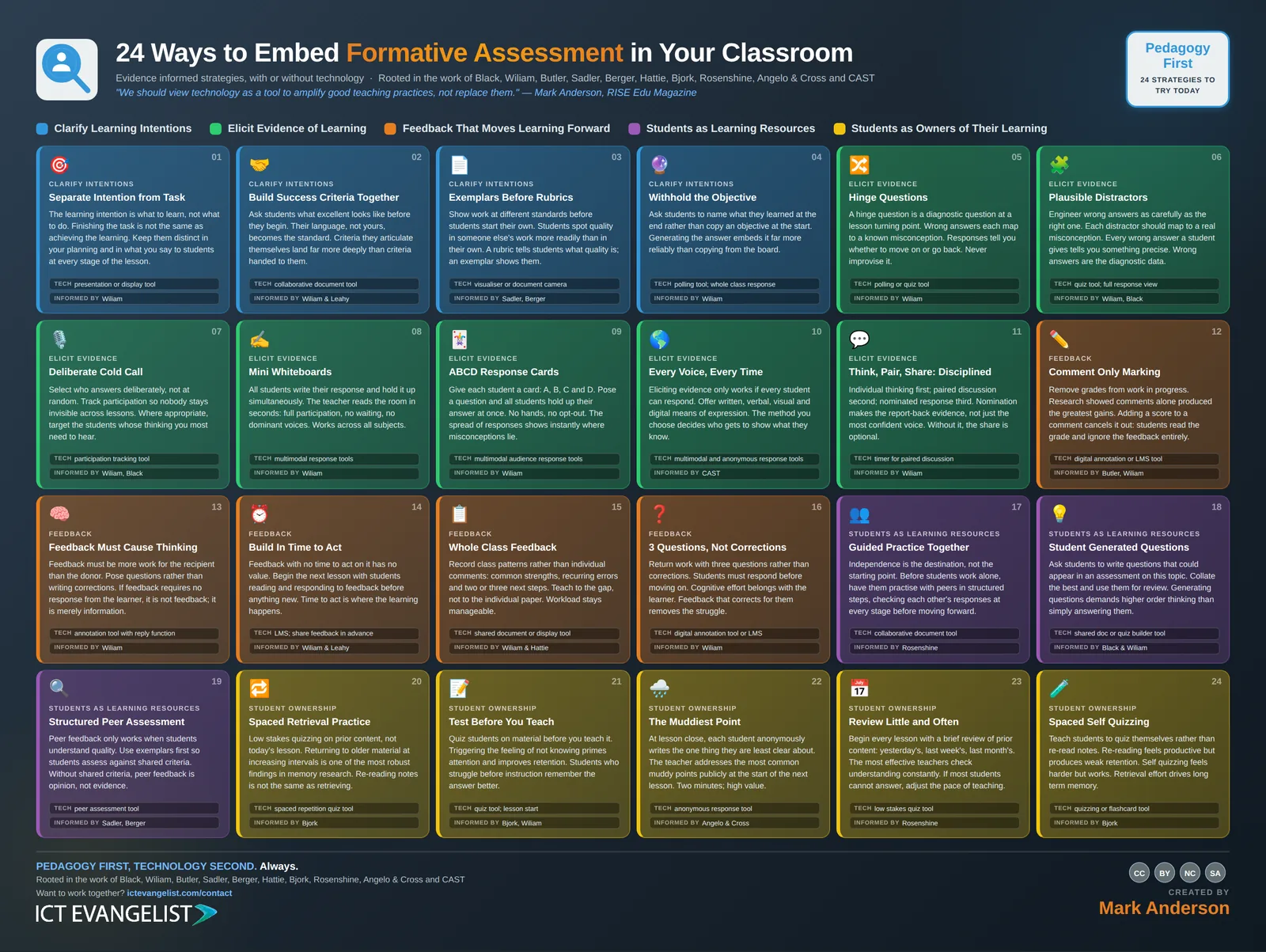
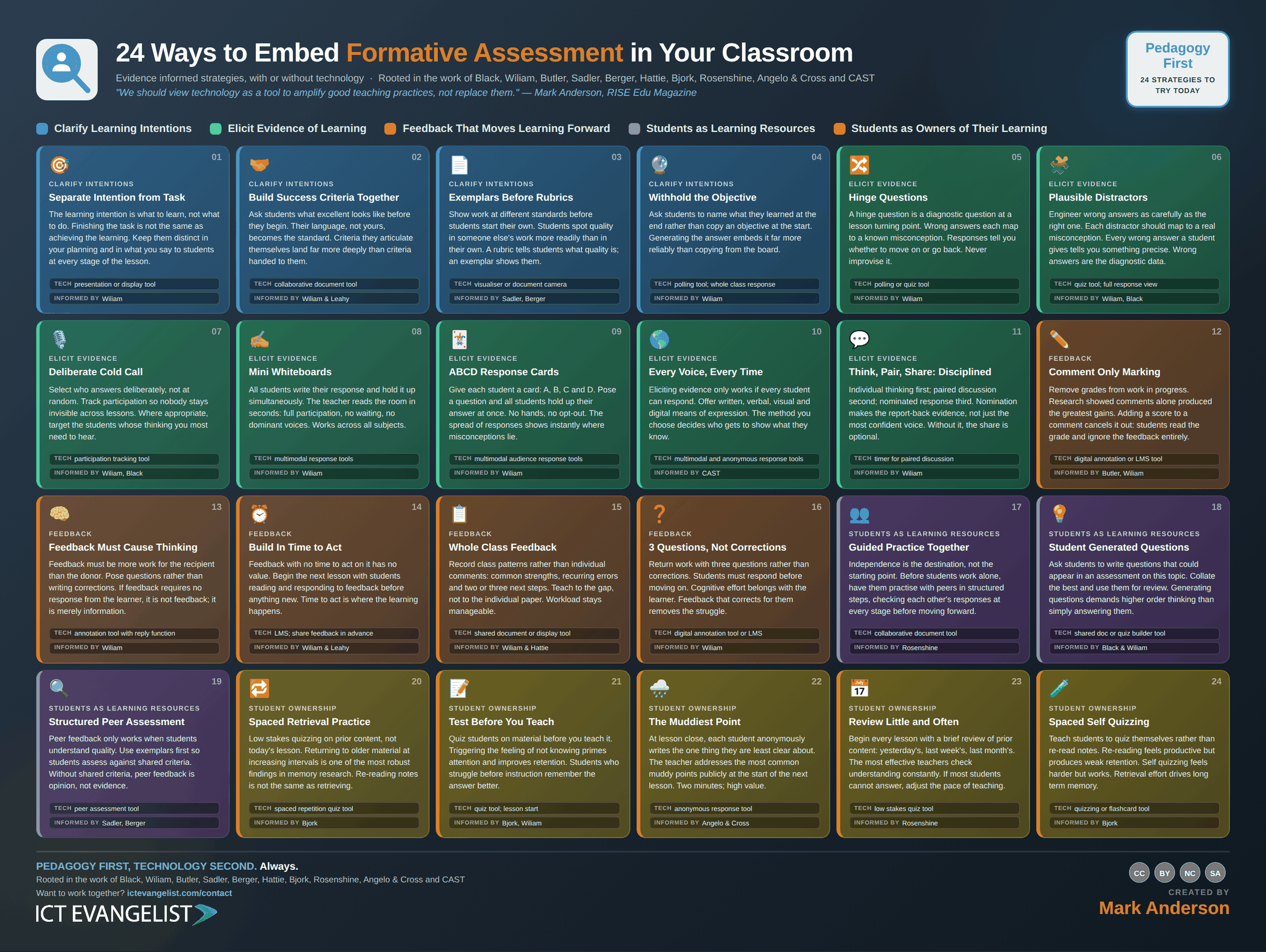
All 24 formative assessment strategies
Each one has its own page, with why you might use it, an example and a way to begin. You'll find them all, with the infographic, in 02 Formative Assessment.
Clarify Learning Intentions
- Separate Intention from Task The learning intention is what to learn, not what to do. Finishing the task is not the same as achieving the learning. Keep them distinct in your planning and in what you say to students at every stage of the lesson. 02 Formative Assessment · Clarify Learning Intentions
- Build Success Criteria Together Ask students what excellent looks like before they begin. Their language, not yours, becomes the standard. Criteria they articulate themselves land far more deeply than criteria handed to them. 02 Formative Assessment · Clarify Learning Intentions
- Exemplars Before Rubrics Show work at different standards before students start their own. Students spot quality in someone else's work more readily than in their own. A rubric tells students what quality is; an exemplar shows them. 02 Formative Assessment · Clarify Learning Intentions
- Withhold the Objective Ask students to name what they learned at the end rather than copy an objective at the start. Generating the answer embeds it far more reliably than copying from the board. 02 Formative Assessment · Clarify Learning Intentions
Elicit Evidence of Learning
- Hinge Questions A hinge question is a diagnostic question at a lesson turning point. Wrong answers each map to a known misconception. Responses tell you whether to move on or go back. Never improvise it. 02 Formative Assessment · Elicit Evidence of Learning
- Plausible Distractors Engineer wrong answers as carefully as the right one. Each distractor should map to a real misconception. Every wrong answer a student gives tells you something precise. Wrong answers are the diagnostic data. 02 Formative Assessment · Elicit Evidence of Learning
- Deliberate Cold Call Select who answers deliberately, not at random. Track participation so nobody stays invisible across lessons. Where appropriate, target the students whose thinking you most need to hear. 02 Formative Assessment · Elicit Evidence of Learning
- Mini Whiteboards All students write their response and hold it up simultaneously. The teacher reads the room in seconds: full participation, no waiting, no dominant voices. Works across all subjects. 02 Formative Assessment · Elicit Evidence of Learning
- ABCD Response Cards Give each student a card: A, B, C and D. Pose a question and all students hold up their answer at once. No hands, no opt-out. The spread of responses shows instantly where misconceptions lie. 02 Formative Assessment · Elicit Evidence of Learning
- Every Voice, Every Time Eliciting evidence only works if every student can respond. Offer written, verbal, visual and digital means of expression. The method you choose decides who gets to show what they know. 02 Formative Assessment · Elicit Evidence of Learning
- Think, Pair, Share: Disciplined Individual thinking first; paired discussion second; nominated response third. Nomination makes the report-back evidence, not just the most confident voice. Without it, the share is optional. 02 Formative Assessment · Elicit Evidence of Learning
Feedback That Moves Learning Forward
- Comment Only Marking Remove grades from work in progress. Research showed comments alone produced the greatest gains. Adding a score to a comment cancels it out: students read the grade and ignore the feedback entirely. 02 Formative Assessment · Feedback That Moves Learning Forward
- Feedback Must Cause Thinking Feedback must be more work for the recipient than the donor. Pose questions rather than writing corrections. If feedback requires no response from the learner, it is not feedback; it is merely information. 02 Formative Assessment · Feedback That Moves Learning Forward
- Build In Time to Act Feedback with no time to act on it has no value. Begin the next lesson with students reading and responding to feedback before anything new. Time to act is where the learning happens. 02 Formative Assessment · Feedback That Moves Learning Forward
- Whole Class Feedback Record class patterns rather than individual comments: common strengths, recurring errors and two or three next steps. Teach to the gap, not to the individual paper. Workload stays manageable. 02 Formative Assessment · Feedback That Moves Learning Forward
- 3 Questions, Not Corrections Return work with three questions rather than corrections. Students must respond before moving on. Cognitive effort belongs with the learner. Feedback that corrects for them removes the struggle. 02 Formative Assessment · Feedback That Moves Learning Forward
Students as Learning Resources
- Guided Practice Together Independence is the destination, not the starting point. Before students work alone, have them practise with peers in structured steps, checking each other's responses at every stage before moving forward. 02 Formative Assessment · Students as Learning Resources
- Student Generated Questions Ask students to write questions that could appear in an assessment on this topic. Collate the best and use them for review. Generating questions demands higher order thinking than simply answering them. 02 Formative Assessment · Students as Learning Resources
- Structured Peer Assessment Peer feedback only works when students understand quality. Use exemplars first so students assess against shared criteria. Without shared criteria, peer feedback is opinion, not evidence. 02 Formative Assessment · Students as Learning Resources
Students as Owners of Their Learning
- Spaced Retrieval Practice Low stakes quizzing on prior content, not today's lesson. Returning to older material at increasing intervals is one of the most robust findings in memory research. Re-reading notes is not the same as retrieving. 02 Formative Assessment · Students as Owners of Their Learning
- Test Before You Teach Quiz students on material before you teach it. Triggering the feeling of not knowing primes attention and improves retention. Students who struggle before instruction remember the answer better. 02 Formative Assessment · Students as Owners of Their Learning
- The Muddiest Point At lesson close, each student anonymously writes the one thing they are least clear about. The teacher addresses the most common muddy points publicly at the start of the next lesson. Two minutes; high value. 02 Formative Assessment · Students as Owners of Their Learning
- Review Little and Often Begin every lesson with a brief review of prior content: yesterday's, last week's, last month's. The most effective teachers check understanding constantly. If most students cannot answer, adjust the pace of teaching. 02 Formative Assessment · Students as Owners of Their Learning
- Spaced Self Quizzing Teach students to quiz themselves rather than re-read notes. Re-reading feels productive but produces weak retention. Self quizzing feels harder but works. Retrieval effort drives long term memory. 02 Formative Assessment · Students as Owners of Their Learning
Quick questions
Formative assessment: quick questions
Can a test be formative assessment?
Yes. What makes assessment formative is what you do with the evidence. A test that's marked, recorded and filed is summative. The same test, used to decide what to reteach and to give pupils something to act on, is formative.
Should formative assessment be graded?
Usually not. Butler's research found that when pupils got a grade and a comment together, they read the grade and ignored the comment. On work in progress, comments alone keep pupils focused on improving the work. Summative pieces can still be graded.
What is a hinge question?
A single diagnostic question at a turning point in the lesson, answered by every pupil. Each wrong answer maps to a known misconception, so the responses tell you whether to move on or go back, and why. Plan it in advance; never improvise it.
What is the muddiest point?
At the end of a lesson, each pupil writes down, anonymously, the one thing they're least clear about. You read them and deal with the most common ones at the start of the next lesson. It takes about two minutes.
Is whole class feedback formative assessment?
It can be. You read the whole set of work for patterns, then share common strengths, recurring errors and two or three next steps with the class. It becomes formative when pupils use it, so build in time for them to act on it.
How often should I use formative assessment?
Every lesson, in small ways. Rosenshine found that the most effective teachers reviewed prior learning and checked understanding constantly. One well planned hinge question per lesson is plenty, alongside quick checks that get an answer from everyone.
Further reading and evidence
Where this thinking comes from
The wider evidence around this area, kept deliberately short. No single study validates all 24 strategies; these are the traditions the thinking comes from, and good places to read further. How this site uses evidence.
- Black & Wiliam (1998), Assessment and Classroom Learning, Assessment in Education. The review that put formative assessment on the map. The original effect sizes have been debated since; the direction of travel has held.
- Black & Wiliam, Inside the Black Box, Phi Delta Kappan. The short version written for teachers, still the clearest statement of the argument.
- Leahy, Lyon, Thompson & Wiliam (2005), Classroom Assessment: Minute by Minute, Day by Day, Educational Leadership. The five formative assessment strategies most schools now use, in their original form.
- Wiliam (2011), Embedded Formative Assessment. The book-length treatment, with the practical techniques behind many of these cards.
More teacher's guides
The other guides, and the model behind them
Want to take this further?
Support is available
If you're a leader wanting help to turn this into professional learning across your school or trust, that's exactly the work I do.