Why I made these
Why I made these.
When I work with schools, before I arrive, the pattern is familiar. Technology not making the impact it should be. Tools often chosen for their features rather than careful thinking about how they solve a problem or serve learning. Effort and budget spent, without much impact in the classroom.
What changes the picture is the order. Start with the pedagogy, work out what the learning or teaching actually needs, and then consider whether a technology helps. It sounds obvious, but it is the step most often skipped. When the schools I work with get this right, outcomes improve, for teachers and for students alike. That is the thread running through all six guides here.
Each guide is built around what the research actually says, not what happens to be trending.
The aim was never to show off what technology can do. It was to start with the teaching, work out what genuinely helps learning, and only then ask where a tool might serve that purpose.
What looks like a single page of strategies sits on top of decades of classroom practice, leadership, research reading and applied work. That is the point of a distillation: the simplicity on the surface is earned by the depth underneath. Use these ideas, adapt them, argue with them, and make them your own.
Explore the ideas, and see if they’re right for your classroom.
The idea
Technology should enhance teaching and learning, not dictate teaching and learning.
When used well, technology helps us go further.
This guide has been a real passion project, combining the ideas of cognitive science with the desire to use technology effectively.
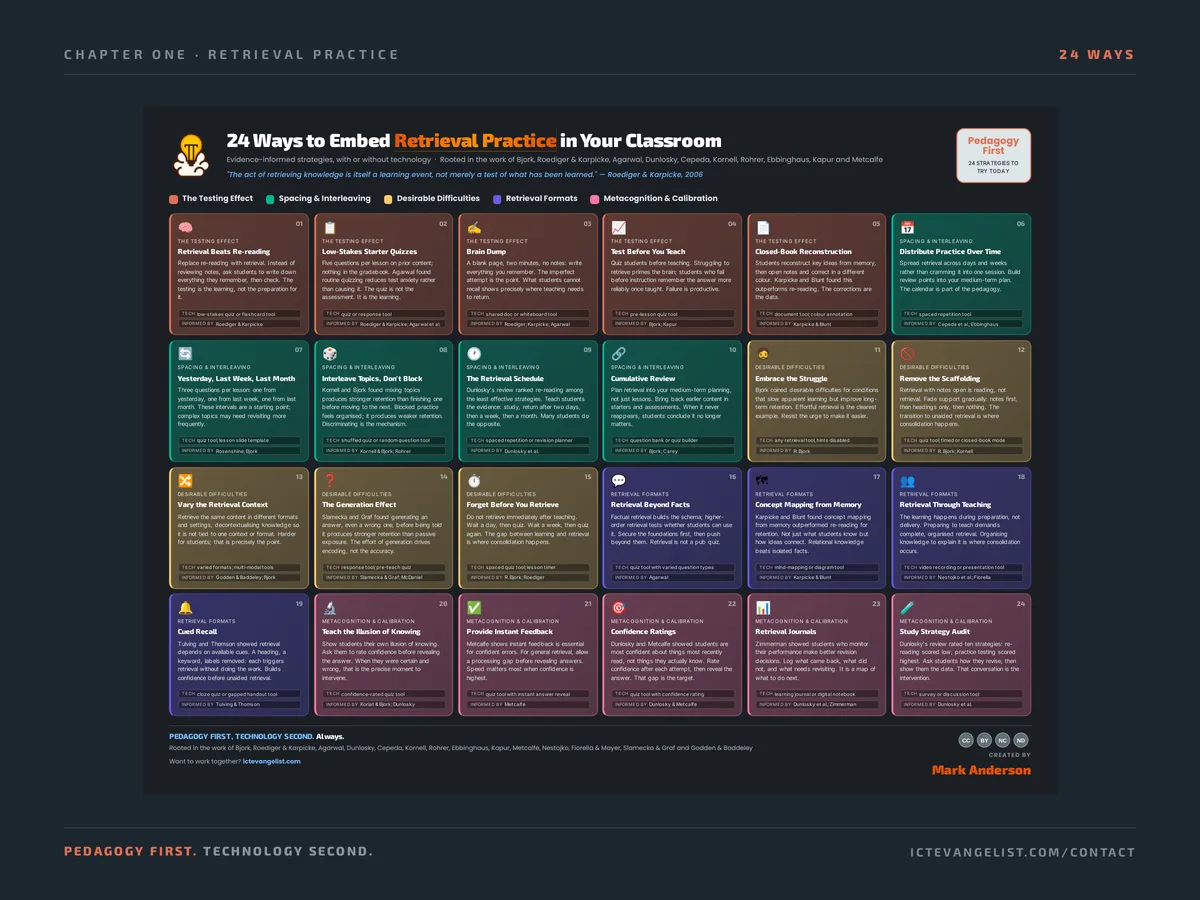
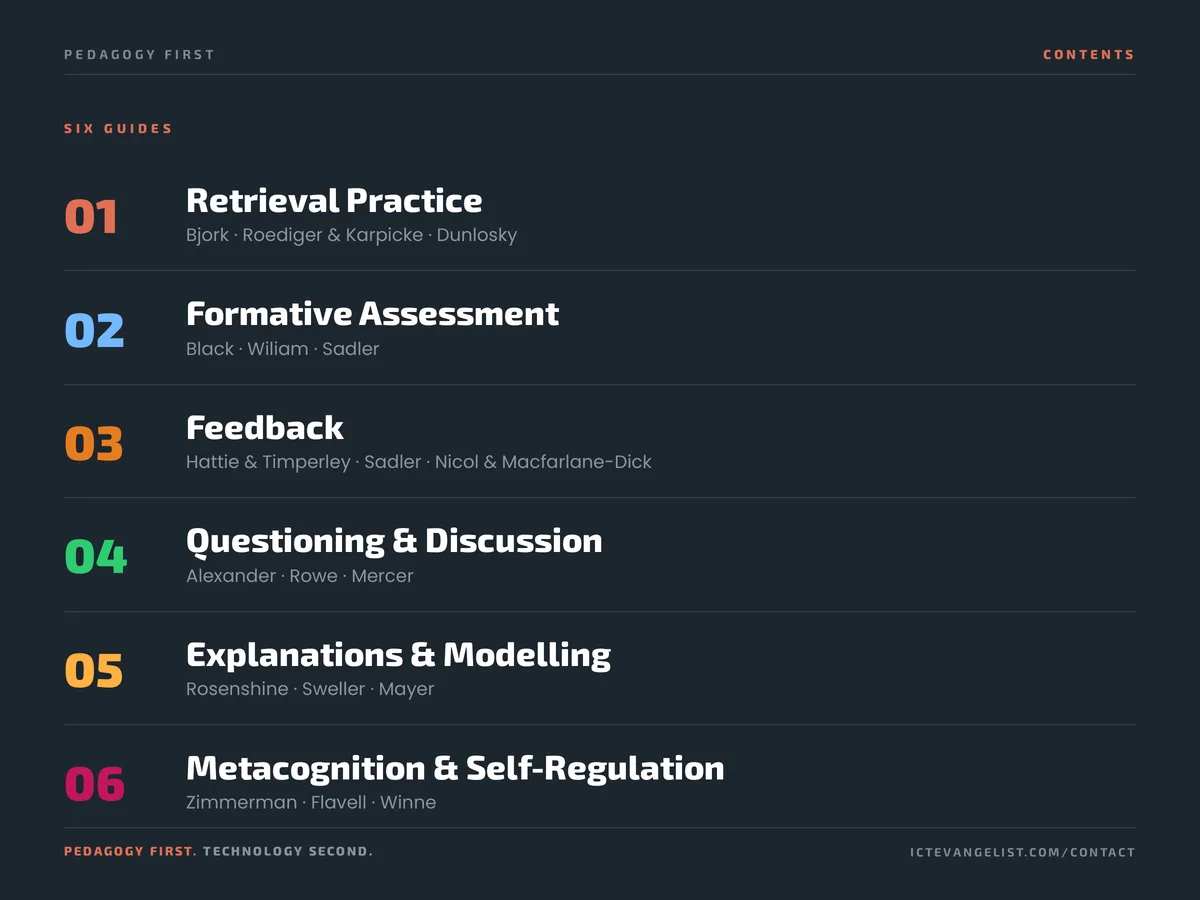
Exploring retrieval practice, formative assessment, feedback, questioning and discussion, explanations and modelling, and metacognition and self-regulation, this guide aims to reinforce the important point that when considering technology use in the classroom, it is a teaching and learning consideration, not a technology consideration. Careful, considered, cognisant choices mean we should choose to use technology when it serves a purpose that helps with learning or teaching. It’s important to remember that sometimes, a mini whiteboard beats anything that needs Wi-Fi and/or a battery.
How to use this guide
How to use this guide.
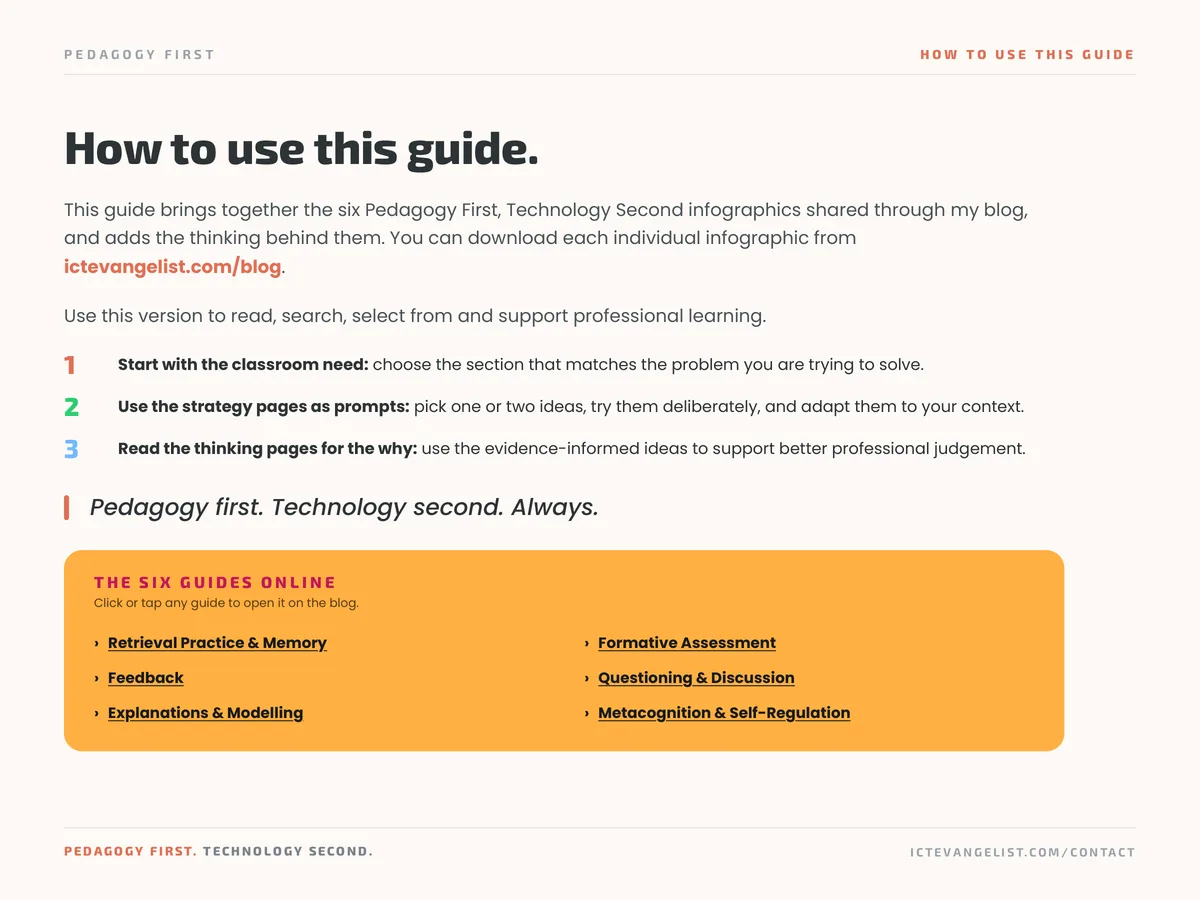
This guide brings together the six Pedagogy First, Technology Second infographics shared through my blog, and adds the thinking behind them. You can download each individual infographic from ictevangelist.com/blog.
Use this version to read, search, select from and support professional learning.
- Start with the classroom need: choose the section that matches the problem you are trying to solve.
- Use the strategy pages as prompts: pick one or two ideas, try them deliberately, and adapt them to your context.
- Read the thinking pages for the why: use the evidence-informed ideas to support better professional judgement.
Pedagogy first. Technology second. Always.
Praise
What Others Say About This Guide
Pedagogy should always be our North Star in education. Learning remains the core business of every classroom, for every student, in every context. Anderson’s guide keeps this principle firmly in view, offering a rich collection of evidence-informed, pedagogy-first strategies that can be applied across classrooms, curricula and systems. Practical, thoughtful and rooted in what matters most, this is a must-read for educators who want technology, strategy and classroom practice to truly and impactfully serve learning.
These guides provide an elegant set of evidence-informed design principles. They offer learning experiences that are served by technology, not driven by it. From these first principles, the guide offers a rich and full menu of evidence-informed, easily navigable ideas, all beautifully organised and codified. This guide opens up learning to the rich possibilities that can follow from a pedagogy-first approach for learners and practitioners alike.
Mark has done the hard thinking, so the rest of us don’t have to. Every strategy here starts with the learning and treats technology as something that has to genuinely add value that can be measured, which is exactly the order schools keep getting wrong.
This is an excellent and much needed resource for all school staff looking to use technology with care and purpose. It avoids gimmicks and trends, focusing instead on evidence-informed practice across areas such as retrieval, formative assessment, feedback, questioning, modelling and metacognition. Above all, it keeps the focus firmly where it belongs, on learners and learning.
This is a really strong, evidence-informed guide that keeps the focus exactly where it should be, on teaching and learning first. The strategies are practical and usable straight away, which makes it particularly helpful as we continue embedding digital across the curriculum in a purposeful and meaningful way. It supports staff to build confidence while developing students’ digital skills with real intent.
This is another strong example of pedagogy led by purpose, grounded in cognitive science and focused on what genuinely supports learning rather than what is fashionable. It reflects a clear commitment to making thoughtful use of whatever tools are available, ensuring the right approach is chosen for the right activity at the right moment in time, helping practitioners make informed, deliberate choices.
Each guide Mark has produced is perfect for any teacher to pick and use straight away. The use of evidence-informed pedagogy and practical classroom strategies provides a clear link before any discussion of technology. I will use this guide to support staff development, inspire classroom practice and support teachers to make purposeful decisions about when technology genuinely adds value rather than using it for its own sake.
I’m always on the lookout for resources that cut through the noise and get straight to what matters in the classroom. Mark’s Pedagogy First guides are not tool or tech with learning theory bolted on; the pedagogy genuinely leads. Each guide distils a substantial body of research into strategies teachers can actually use on Monday morning. And as ever, Mark is generous with his sharing; no gatekeeping. Thanks, Mark.
About Mark
Mark Anderson. Thirty years in education, and a leading voice on pedagogy and technology.
An award winning author, globally sought after keynote speaker, trainer and strategic consultant in education technology, AI and digital strategy, Mark works independently as ICT Evangelist and part time as Principal Education Consultant at NetSupport. He was the lead education and AI consultant on the BBC Bitesize Guide to AI.
He co-authored the Amazon chart topping The EdTech Playbook with Olly Lewis, and his earlier Perfect ICT Every Lesson topped the Amazon charts too. He is a Founding Fellow of the Chartered College of Teaching, an Independent Thinking Associate, a member of the BCS Schools and Colleges committee, and an Apple Distinguished Educator, Google Certified Innovator and Microsoft Certified Educator.
His blog won UK Education Blog of the Year, he co-founded the Digital Leader Network and the GESS award winning LearnLiveUAE, and he keynotes at the world’s major education events, among them BETT and GESS. He works with leading schools and trusts including the British School of Barcelona, Downe House, Dubai College and JESS Dubai, and ACT, Woodland, Black Pear, Stamford Park, Gloucestershire Learning Alliance, Oak Trees and Nova Education Trust.
That work sits alongside long relationships with many of the EdTech companies shaping the sector, among them Microsoft, Apple, Google, ClickView, Now Press Play, IRIS, CENTURY Tech, Adobe and NetSupport. It was this work that first led him to join NetSupport as their Head of Education, and now as their Principal Education Consultant.
That reach is built on decades in the classroom and in a range of middle and senior leadership roles, from head of department to senior leader, alongside a spell as a local authority lead teacher for computing and the teaching and learning lead on Clevedon School’s pioneering 1:1 rollout. One idea runs through all of it: good teaching comes first, and technology earns its place only when it serves the learning.
Work with Mark
Bring this thinking to your school or trust.
Keynotes, INSET, workshops and strategic consultancy on pedagogy, AI and digital strategy, tailored to where your team is and built on a relationship over time.
Don’t just book a one off. The magic comes from building a relationship over time where he can understand your needs and help you develop digital strategy in a sustainable way.
Mark is an excellent communicator who delivers a clear and meaningful message. He exudes confidence and brings people with him.
He used his wide scope of knowledge and expertise to support and train, as well as write up, publish and share. His values are clear and shine through in all his interactions.
Mark was a great addition to our conference and would definitely be a positive addition to other trusts for a keynote, CPD or twilight session.