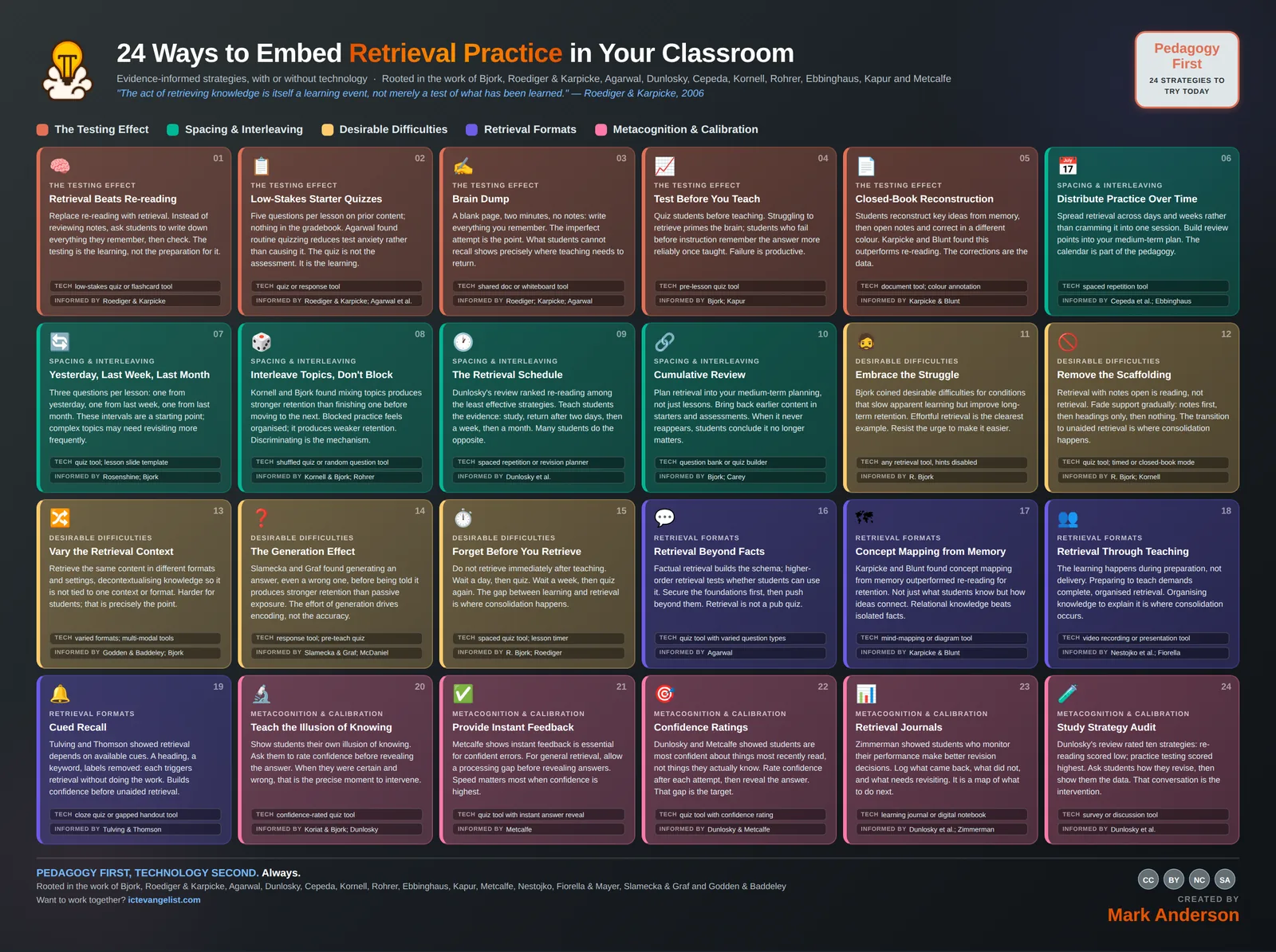
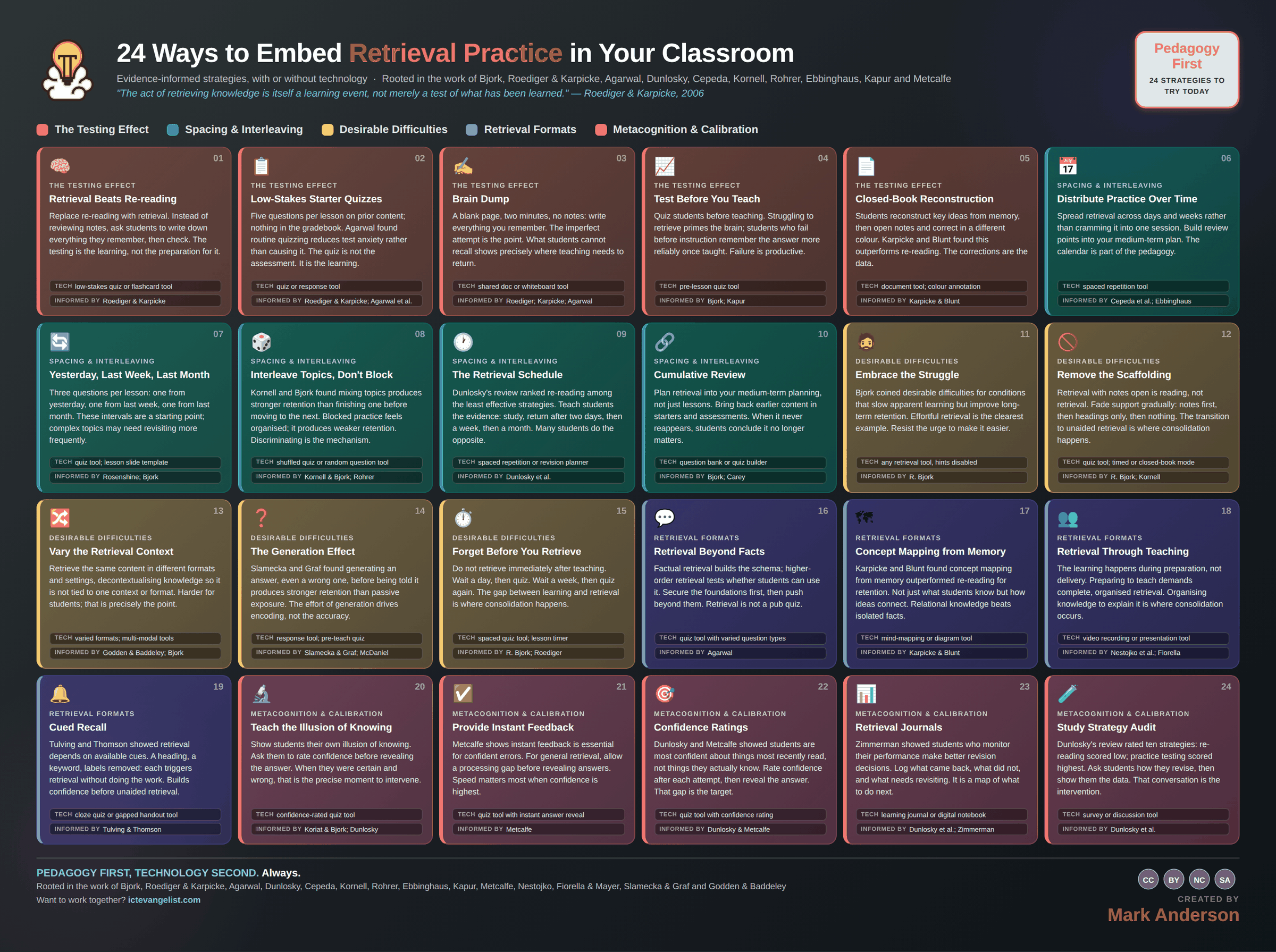
Bjork coined desirable difficulties for conditions that slow apparent learning but improve long-term retention. Effortful retrieval is the clearest example. Resist the urge to make it easier.
Choose the version of a task that feels harder in the lesson when the evidence says it retains better. Effortful retrieval is the clearest example, but so are spacing, interleaving and reduced scaffolding.
Why it works
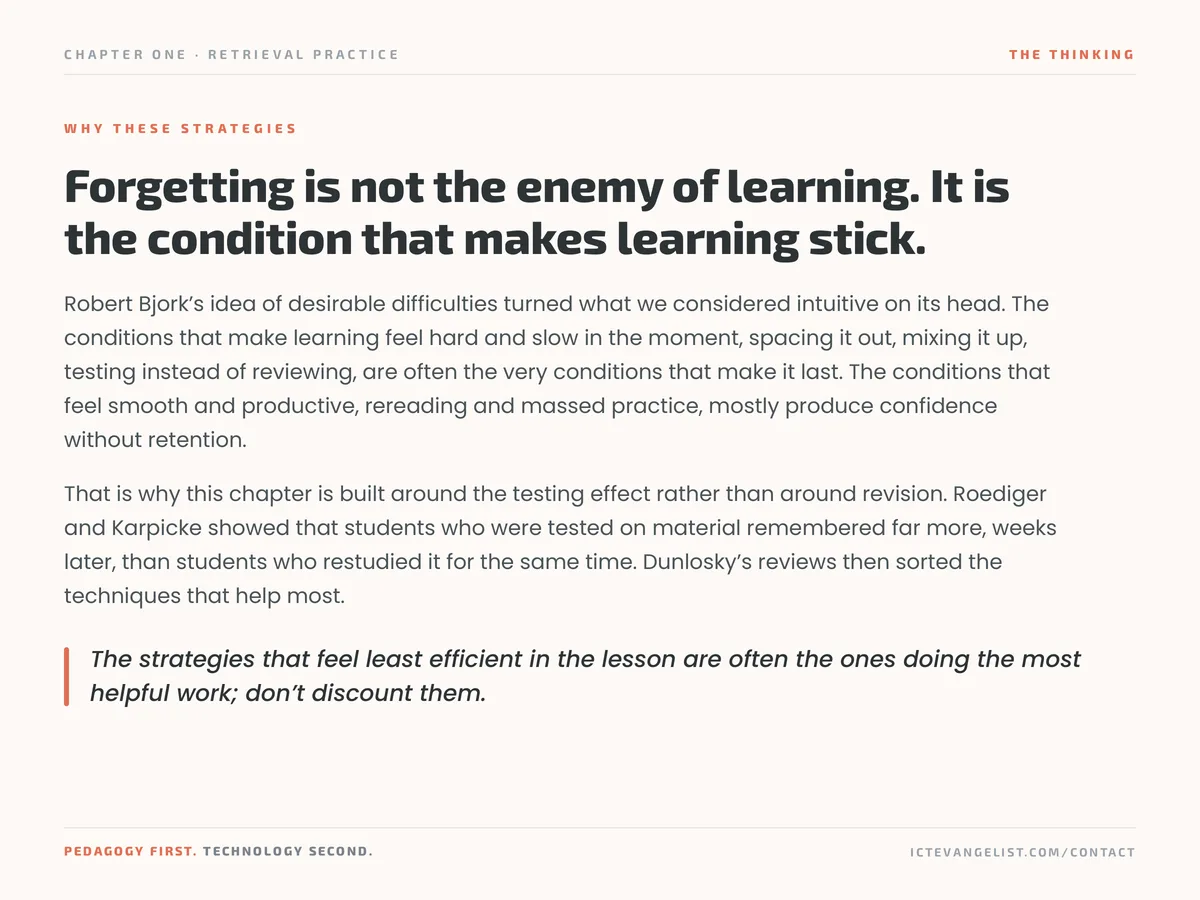
Bjork coined desirable difficulties for exactly this: conditions that slow apparent learning during instruction but improve retention and transfer afterwards. The uncomfortable part is that fluency during a lesson is a poor guide to learning, and both teachers and students read it as a good one.
How to run it
- Notice where you've made something easier out of kindness and ask whether it removed the thinking.
- Delay the hint. Count to five before you offer it.
- Let a struggle run a little longer than is comfortable before you intervene.
- Explain to the class why the lesson feels harder, so it doesn't read as poor teaching.
Where technology serves
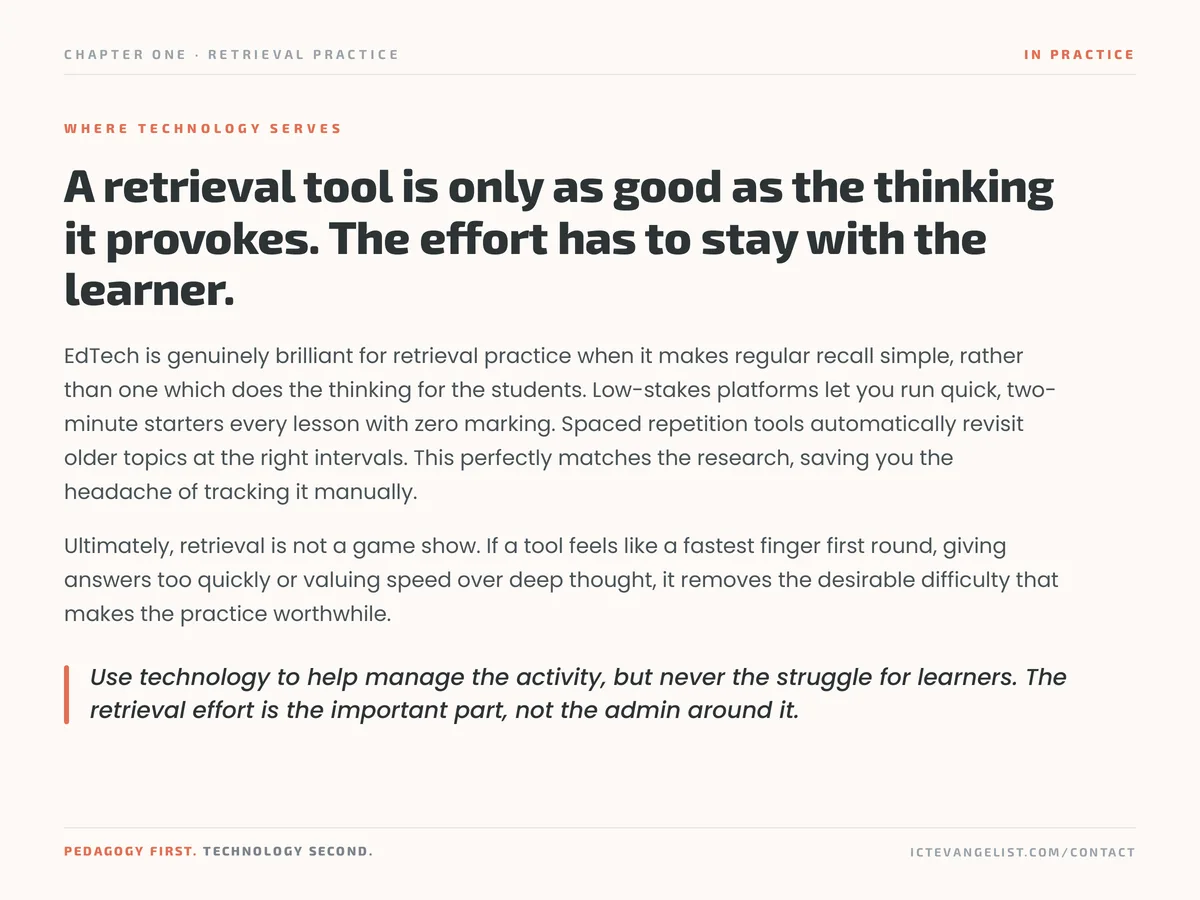
Any retrieval tool works, with hints and multiple-choice options disabled. The default settings on most platforms are tuned for engagement, not for difficulty.
Watch for: Desirable is doing real work in that phrase. Difficulty that a student has no route through is just difficulty, and it teaches them that the subject isn't for them.
Techany retrieval tool, hints disabledInformed byR. Bjork#11
Retrieval with notes open is reading, not retrieval. Fade support gradually: notes first, then headings only, then nothing. The transition to unaided retrieval is where consolidation happens.
Why it works
Bjork and Kornell's work on scaffolding and retrieval shows that support which is never withdrawn produces performance that collapses the moment it's removed. Fading isn't a nicety at the end; it's the mechanism by which the student takes over.
How to run it
- Plan three passes over the content with decreasing support.
- Pass one: notes available, focus on getting the shape right.
- Pass two: headings or a skeleton only.
- Pass three: blank page.
- Be explicit that the third pass is the one that counts for their own judgement of what they know.
Where technology serves
A quiz tool with a closed-book or timed mode enforces the final pass in a way that trusting to willpower doesn't.
Watch for: Fading only works if you actually do it. Scaffolds have a habit of becoming permanent because removing them makes the class look less successful for a week.
Techquiz tool; timed or closed-book modeInformed byR. Bjork; Kornell#12
Retrieve the same content in different formats and settings, decontextualising knowledge so it is not tied to one context or format. Harder for students; that is precisely the point.
Retrieve the same knowledge in different formats and settings: written one week, spoken the next, as a diagram the week after, in a different room or a different order.
Why it works
Godden and Baddeley's divers famously recalled better in the environment where they learned, which tells you memory picks up contextual cues you didn't intend to teach. Varying the context decontextualises the knowledge, so it isn't welded to one format, one room or one question style. It's harder for students, and that's precisely the point.
How to run it
- Rotate the format of your recall activities rather than settling on a favourite.
- Ask for the same content as prose, as a diagram, as an explanation to a partner.
- Occasionally change where or when the retrieval happens.
- Vary the question wording so recall isn't tied to a phrasing.
Where technology serves
Multi-modal tools let you switch format without rebuilding the activity each time: the same content as a quiz, a mind map, a voice note.
Watch for: Variety for its own sake becomes novelty-chasing. The variation has to be in how the knowledge is retrieved, not in how entertaining the packaging is.
Techvaried formats; multi-modal toolsInformed byGodden & Baddeley; Bjork#13
Slamecka and Graf found generating an answer, even a wrong one, before being told it produces stronger retention than passive exposure. The effort of generation drives encoding, not the accuracy.
Have students produce an answer before they're given it, even when you know the answer will be wrong. Generating beats being told, and generating badly still beats being told.
Why it works
Slamecka and Graf's generation effect showed that words a participant produced were remembered better than words they read, and McDaniel's later work extended it to classroom material. The effort of generation is what drives the encoding. Accuracy is close to irrelevant at that moment.
How to run it
- Before defining a term, ask what they think it might mean.
- Before giving the method, ask how they'd approach it.
- Take a few answers without correcting them yet.
- Then teach, and explicitly connect back to what they guessed.
Where technology serves
A response tool captures every student's guess rather than the three you've time to hear, and lets you show the spread of thinking before you resolve it.
Watch for: If wrong guesses get visibly corrected in front of the class in a way that stings, students learn to stay quiet, and the generation stops happening.
Techresponse tool; pre-teach quizInformed bySlamecka & Graf; McDaniel#14
Do not retrieve immediately after teaching. Wait a day, then quiz. Wait a week, then quiz again. The gap between learning and retrieval is where consolidation happens.
Why it works
Retrieval immediately after instruction is easy because the material is still in working memory, and easy retrieval strengthens little. Bjork's storage and retrieval strength distinction explains it: you need retrieval strength to have dropped somewhat for the act of retrieving to do useful work. Some forgetting is a precondition.
How to run it
- Resist the end-of-lesson quiz on today's content as a measure of learning. Use it as a check of attention instead.
- Put the real retrieval a lesson or two later.
- Make the delay explicit to students so the difficulty is expected.
- Track which items need shorter gaps because they keep coming back blank.
Where technology serves
A spaced quiz tool handles the delay for you. Without one, the intention to come back in three days rarely survives contact with a busy week.
Watch for: An immediate end-of-lesson quiz that everybody passes is reassuring and tells you almost nothing about what will still be there in a fortnight.
Techspaced quiz tool; lesson timerInformed byR. Bjork; Roediger#15