Feedback Is Not Marking
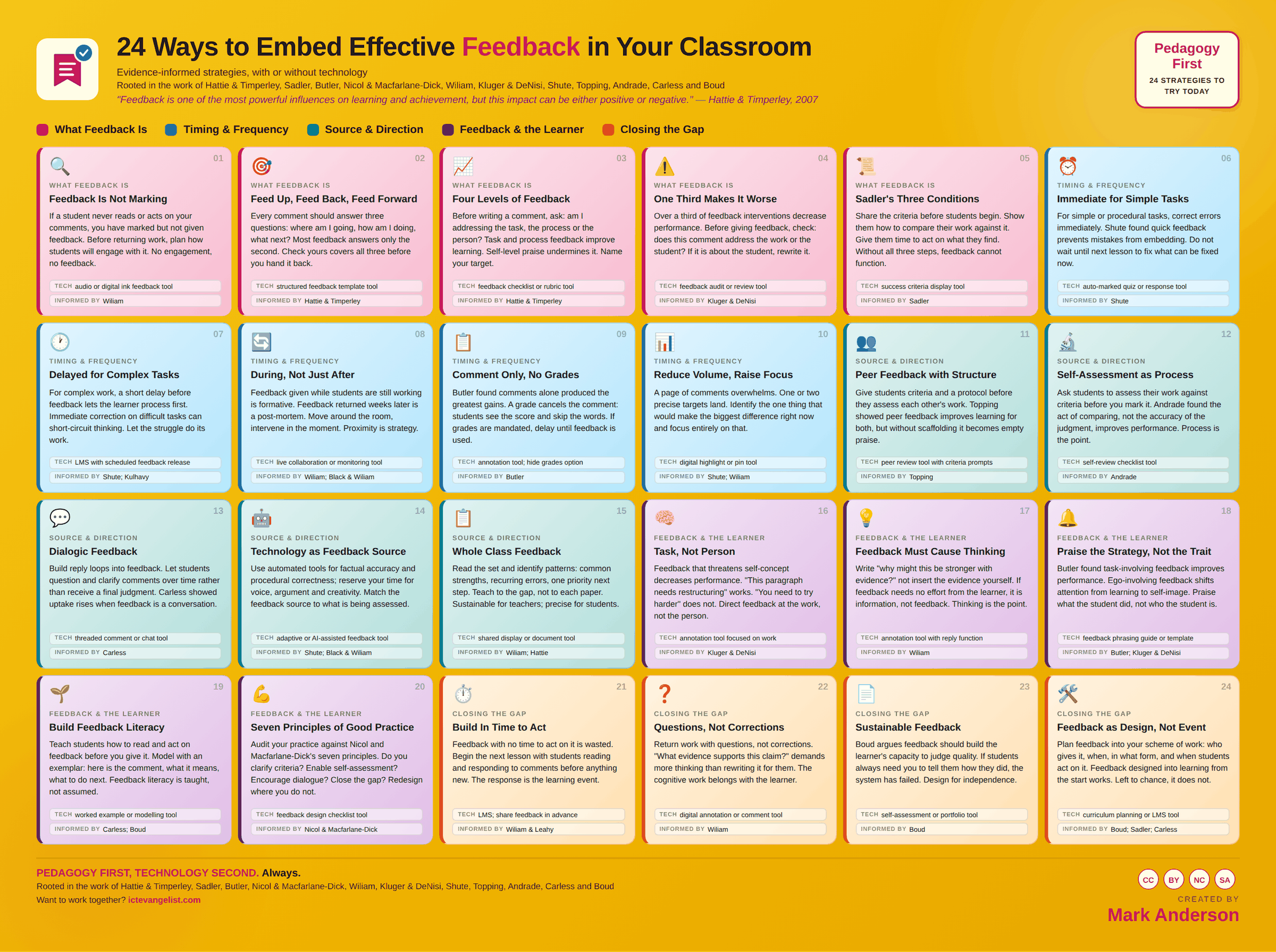
If a student never reads or acts on your comments, you have marked but not given feedback. Before returning work, plan how students will engage with it. No engagement, no feedback.
Find this under Make feedback more useful
Chapter Three
Feedback is too often treated as another word for marking. It isn’t. Good feedback gives pupils information they can use to improve what they do next, and that is a far higher bar than writing a comment in the margin.
Rooted in the work of Hattie & Timperley, Sadler, Nicol & Macfarlane-Dick and others
The infographic
The strategies
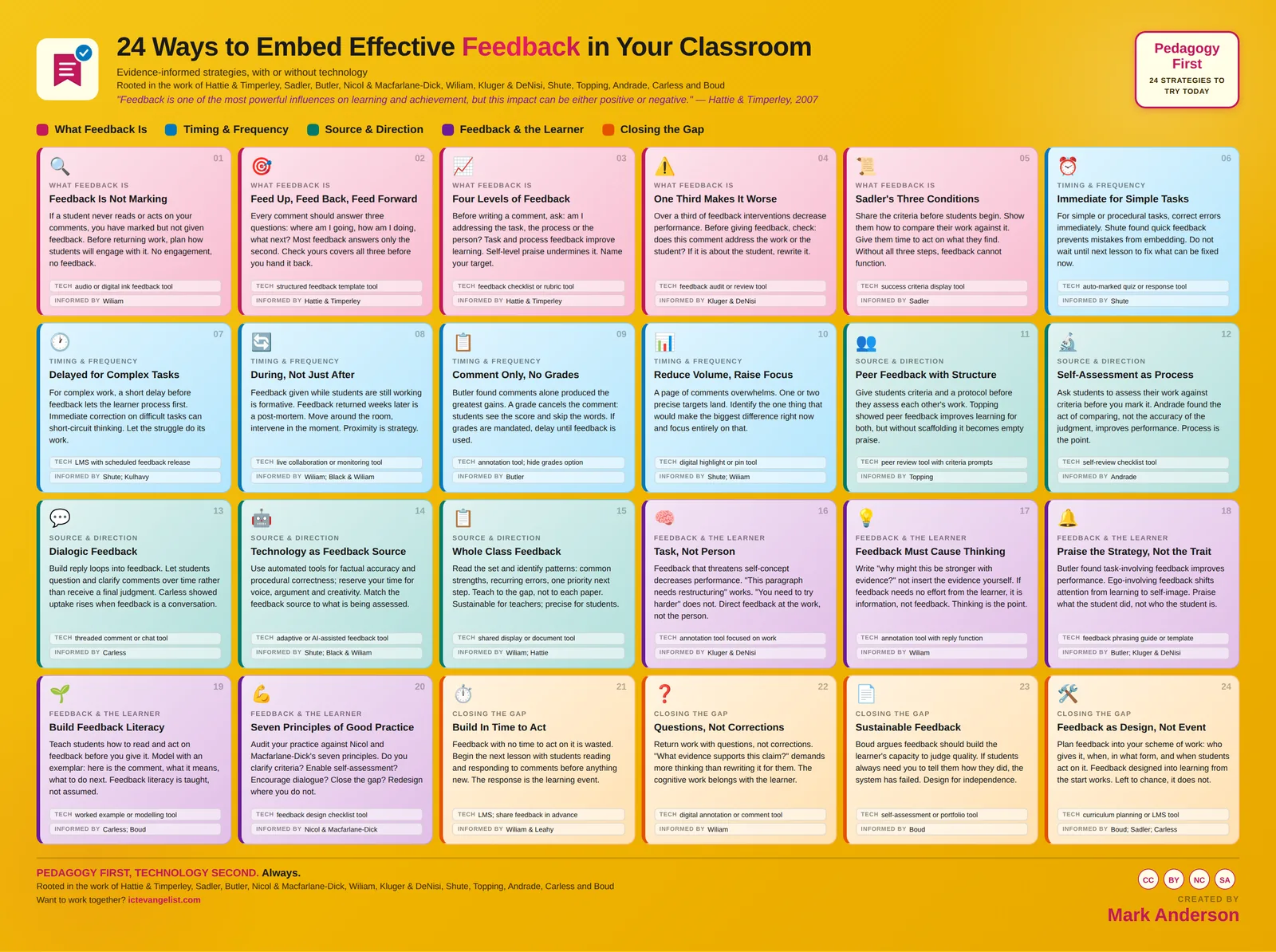
Each strategy below is written exactly as it appears on the card.
If a student never reads or acts on your comments, you have marked but not given feedback. Before returning work, plan how students will engage with it. No engagement, no feedback.
Find this under Make feedback more useful
Every comment should answer three questions: where am I going, how am I doing, what next? Most feedback answers only the second. Check yours covers all three before you hand it back.
Find this under Make feedback more useful
Before writing a comment, ask: am I addressing the task, the process or the person? Task and process feedback improve learning. Self-level praise undermines it. Name your target.
Find this under Make feedback more useful
Over a third of feedback interventions decrease performance. Before giving feedback, check: does this comment address the work or the student? If it is about the student, rewrite it.
Share the criteria before students begin. Show them how to compare their work against it. Give them time to act on what they find. Without all three steps, feedback cannot function.
For simple or procedural tasks, correct errors immediately. Shute found quick feedback prevents mistakes from embedding. Do not wait until next lesson to fix what can be fixed now.
For complex work, a short delay before feedback lets the learner process first. Immediate correction on difficult tasks can short-circuit thinking. Let the struggle do its work.
Feedback given while students are still working is formative. Feedback returned weeks later is a post-mortem. Move around the room, intervene in the moment. Proximity is strategy.
Butler found comments alone produced the greatest gains. A grade cancels the comment: students see the score and skip the words. If grades are mandated, delay until feedback is used.
Find this under Make feedback more useful
A page of comments overwhelms. One or two precise targets land. Identify the one thing that would make the biggest difference right now and focus entirely on that.
Find this under Make feedback more useful · Inclusive practice: feedback and next steps · Try this tomorrow
Give students criteria and a protocol before they assess each other's work. Topping showed peer feedback improves learning for both, but without scaffolding it becomes empty praise.
Ask students to assess their work against criteria before you mark it. Andrade found the act of comparing, not the accuracy of the judgment, improves performance. Process is the point.
Find this under Build independence · Inclusive practice: independence and self regulation
Build reply loops into feedback. Let students question and clarify comments over time rather than receive a final judgment. Carless showed uptake rises when feedback is a conversation.
Find this under Help pupils act on feedback
Use automated tools for factual accuracy and procedural correctness; reserve your time for voice, argument and creativity. Match the feedback source to what is being assessed.
Find this under Use technology with greater purpose
Read the set and identify patterns: common strengths, recurring errors, one priority next step. Teach to the gap, not to each paper. Sustainable for teachers; precise for students.
Find this under Make feedback more useful
Feedback that threatens self-concept decreases performance. "This paragraph needs restructuring" works. "You need to try harder" does not. Direct feedback at the work, not the person.
Find this under Make feedback more useful · Inclusive practice: feedback and next steps
Write "why might this be stronger with evidence?" not insert the evidence yourself. If feedback needs no effort from the learner, it is information, not feedback. Thinking is the point.
Find this under Help pupils act on feedback
Butler found task-involving feedback improves performance. Ego-involving feedback shifts attention from learning to self-image. Praise what the student did, not who the student is.
Teach students how to read and act on feedback before you give it. Model with an exemplar: here is the comment, what it means, what to do next. Feedback literacy is taught, not assumed.
Find this under Help pupils act on feedback · Inclusive practice: feedback and next steps
Audit your practice against Nicol and Macfarlane-Dick's seven principles. Do you clarify criteria? Enable self-assessment? Encourage dialogue? Close the gap? Redesign where you do not.
Feedback with no time to act on it is wasted. Begin the next lesson with students reading and responding to comments before anything new. The response is the learning event.
Find this under Help pupils act on feedback · Inclusive practice: feedback and next steps
Return work with questions, not corrections. "What evidence supports this claim?" demands more thinking than rewriting it for them. The cognitive work belongs with the learner.
Find this under Help pupils act on feedback · Inclusive practice: feedback and next steps · Try this tomorrow
Boud argues feedback should build the learner's capacity to judge quality. If students always need you to tell them how they did, the system has failed. Design for independence.
Find this under Build independence · Inclusive practice: independence and self regulation
Plan feedback into your scheme of work: who gives it, when, in what form, and when students act on it. Feedback designed into learning from the start works. Left to chance, it does not.
The thinking
Hattie and Timperley’s work showed us that feedback can have a powerful effect on achievement, but it is not automatically useful. Some feedback helps, some does very little, and some can make things worse.
Sadler’s work found the important bit that is often missed. Feedback only works when learners understand what quality looks like, can compare their work against it, and know how to close the gap. Nicol and Macfarlane Dick took this further by placing feedback within self-regulation, helping pupils become better at judging and improving their own work.
Butler’s study is a useful warning too. When grades sit alongside comments, pupils often look at the grade and miss the guidance.
In practice
Digital annotation, audio comments and shared documents can shorten the gap between work and response to almost nothing. That matters. Feedback given while the work is still fresh has a far better chance of shaping what pupils do next than feedback returned two weeks later.
Used well, the same tools also make whole-class feedback more manageable. You can spot common patterns, address them quickly, and avoid writing the same comment thirty times.
The trap is automated feedback that gives a score, a tick, or a badge and stops there. That may be useful information, but it is ultimately unhelpful. Feedback earns its keep when pupils have time to think, improve, redraft, correct, compare or try again.
The win is not faster feedback. The win is better work because pupils had time to use it.
Further reading and evidence
The wider evidence around this area, kept deliberately short. No single study validates all 24 strategies; these are the traditions the thinking comes from, and good places to read further. How this site uses evidence.
Use this for professional learning
Is the effort you spend marking coming back as learning?. A 30 minute activity for a department, phase or professional learning group, using this guide as it stands.
The model behind this, and how to run it across a school or trust, is on the professional learning page.