The short answer
Metacognition is thinking about your own thinking: knowing how you learn, and using that to plan a task, check how it's going and change course when it isn't working. In the classroom it means teaching pupils to set a goal, pick a strategy on purpose, monitor their understanding and evaluate the result, so self-regulation is something they're taught rather than something the lucky ones pick up.
What are some examples of metacognition in the classroom?
It looks like pupils thinking about how they're doing the work, as well as doing it. Saying what a good answer would include before they start, naming the method they'll use and why, pausing mid-task to ask whether it's still working, and comparing their finished work against an exemplar.
A worded maths problem gets annotated together before anyone solves it, so the quantity being asked for is circled and the step most likely to catch people out gets a warning mark. Fifteen minutes into an extended piece of writing, a timer marks a stop point and everyone answers one question: is my approach still working, and how do I know?
None of this needs anything special. A one-line margin note saying why a pupil took a step, or a predicted score written down before the quiz is marked, makes invisible thinking visible, so you and they can look at the process as well as the product.
What is self-regulated learning?
Self-regulated learning is pupils managing their own learning in a cycle: looking ahead and planning, monitoring how it's going while they work, then reflecting on the result and using that to improve the next attempt. Zimmerman showed that self-regulation works as a cycle learners can get better at, which means it can be taught.
In Zimmerman's forethought phase, learners analyse the task, set a specific goal, choose a strategy and bring an expectation of how they'll do. In the performance phase, they monitor their understanding and manage their attention while they work. In the self-reflection phase, they judge their work against a standard and explain the result to themselves, and that feeds straight into the next round of planning.
Metacognition sits inside this cycle. Flavell gave us the language of metacognition, helping us see that pupils can become more aware of their own thinking, and Winne took it further by showing how learners should monitor and adjust while the work is happening, as well as after it's finished.
The three phases of the cycle
- Forethought: analyse the task, set the goal, pick a strategy
- Performance: monitor understanding and manage attention while working
- Self-reflection: judge against a standard, explain the result, plan the next attempt
What does the EEF guidance say about metacognition?
The Education Endowment Foundation's guidance report on metacognition and self-regulated learning is the one most schools start with. It makes seven recommendations, and explicit teaching of strategies is among them, so pupils are taught a named strategy and how to use it before they're expected to use it on their own.
Behind the guidance sits a fuller evidence review by Muijs and Bokhove (2020), and it's honest about where the evidence is strong and where it thins. That's worth knowing before anyone sells you a metacognition programme. It's a good reason to try strategies deliberately and look at what happens with your own pupils.
The thinking behind it goes back a long way. Flavell's 1979 paper is where the term begins, and Zimmerman's 2002 overview set out the forethought, performance and self-reflection cycle that sits behind many of the strategies in this guide.
Where this research comes from
- Where the term metacognition begins: Flavell
- The self-regulation cycle: Zimmerman
- Monitoring while you work, and conditional knowledge: Winne
- Feedback and self-regulation as one loop: Butler
- Knowledge before strategy: Willingham
- The EEF evidence review: Muijs and Bokhove
How do you teach metacognition explicitly?
Name the strategy, model it out loud, practise it with prompts, then fade the prompts. Teach it inside your subject, on content pupils already know, so they learn to self-regulate this topic. Telling pupils to reflect more won't build the habit; it has to be taught, modelled, practised and gradually handed over.
Order is important here. Pupils can't plan or monitor a task they know nothing about, so teach the content first, because metacognition works on knowledge, never instead of it. Then teach the method as a named strategy with steps, like retrieval, spacing or self-explanation, along with the cues that tell pupils when it's the right one to reach for.
Model it before you expect it. The questions an expert asks themselves look obvious precisely because the expert no longer notices asking them, so think aloud. Then move from modelled, to guided, to independent use, removing prompts as pupils show they no longer need them, and bringing them back for anyone who struggles.
What are the best metacognitive strategies for the classroom?
The best strategies give pupils something concrete to steer by: a goal set before they start, a method chosen on purpose, planned stop points to check it's working, an exemplar to judge against, and one specific change to make next time. Each one is small, and each one hands a piece of the thinking over to the pupil.
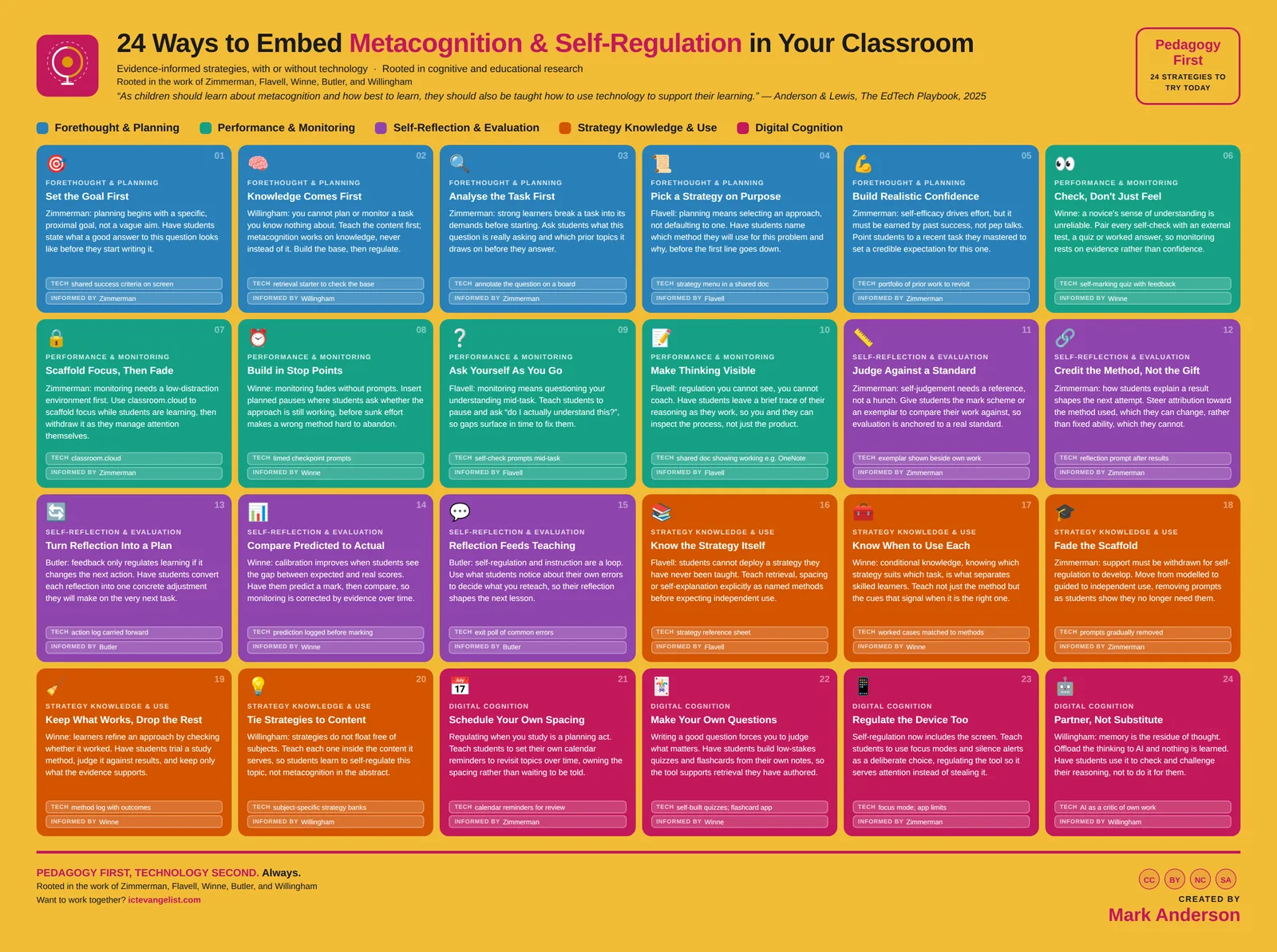
In the guide I've grouped 24 strategies into five families: forethought and planning, performance and monitoring, self-reflection and evaluation, strategy knowledge and use, and digital cognition. The full list is further down this page, and each one has its own page with an example, a way to begin and what to look out for.
If you're starting from scratch, pick one. Asking pupils what a good answer would include before they start, or having them predict their score before a quiz is marked, are both quick to set up and easy to keep going.
What are the common mistakes with teaching metacognition?
The common mistakes are teaching it as a separate study skills lesson, asking pupils to reflect with nothing to reflect against, trusting how confident pupils feel, and never removing the prompts. Each one leaves pupils going through the motions without building the habit of regulating their own learning.
Reflection that ends with "I should be more careful" changes nothing on Monday. Reflection only really counts as metacognition when it changes what the learner does next, so turn each one into a single concrete adjustment for the very next task. And a novice's sense of understanding is unreliable, so pair every self-check with an external one, like a quick quiz or a worked answer.
Strategies taught in the abstract tend to stay there, because self-regulating an essay is a different act from self-regulating a proof. And if the prompts never come away, pupils never get the chance to remember to plan, check and reflect for themselves, which is the bit we're actually after.
How can technology and AI help with metacognition?
Technology helps when it scaffolds the regulation and is then faded. Learning journals, planning tools and self-marking quizzes can make invisible thinking visible and give pupils evidence to check their confidence against. AI can act as a critic of work a pupil has already done, as long as the pupil does the judging.
The risk is a tool that monitors and corrects so smoothly that the pupil never has to, removing the very work that builds the capacity. Willingham's line, that memory is the residue of thought, applies here: if pupils offload the thinking to AI, nothing is learned, however polished the work looks. Scaffold the regulation, then fade the scaffold. The goal is a learner who no longer needs the tool.
Pedagogy first, technology second. Teaching pupils to switch on focus modes and silence alerts as a deliberate choice is self-regulation too, because the environment they manage now includes the screen. And when AI critiques a pupil's work, pupils need to treat its feedback the same way you would: check its work, like every child in your classroom.
How do I start teaching metacognition tomorrow?
Before your next extended task, ask the class what a good answer to this question would include, and take suggestions before anyone writes a word. Agree a shared version, leave it on the board while they work, and ask them to check their work against it before they hand it in. It takes two minutes and needs no preparation.
Keep it going for a few weeks before you judge it. Pupils new to this will come up with woolly criteria at first, so model it for them. Then look at what's happening: whether the goals get more specific, whether anyone refers back to them mid-task, and whether, in time, pupils start setting the goal without being asked.
From the guide
All 24 metacognition strategies
Each one has its own page, with why you might use it, an example and a way to begin. You'll find them all, with the infographic, in 06 Metacognition & Self-Regulation.
Forethought & Planning
- Set the Goal First Zimmerman: planning begins with a specific, proximal goal, not a vague aim. Have students state what a good answer to this question looks like before they start writing it. 06 Metacognition & Self-Regulation · Forethought & Planning
- Knowledge Comes First Willingham: you cannot plan or monitor a task you know nothing about. Teach the content first; metacognition works on knowledge, never instead of it. Build the base, then regulate. 06 Metacognition & Self-Regulation · Forethought & Planning
- Analyse the Task First Zimmerman: strong learners break a task into its demands before starting. Ask students what this question is really asking and which prior topics it draws on before they answer. 06 Metacognition & Self-Regulation · Forethought & Planning
- Pick a Strategy on Purpose Flavell: planning means selecting an approach, not defaulting to one. Have students name which method they will use for this problem and why, before the first line goes down. 06 Metacognition & Self-Regulation · Forethought & Planning
- Build Realistic Confidence Zimmerman: self-efficacy drives effort, but it must be earned by past success, not pep talks. Point students to a recent task they mastered to set a credible expectation for this one. 06 Metacognition & Self-Regulation · Forethought & Planning
Performance & Monitoring
- Check, Don't Just Feel Winne: a novice's sense of understanding is unreliable. Pair every self-check with an external test, a quiz or worked answer, so monitoring rests on evidence rather than confidence. 06 Metacognition & Self-Regulation · Performance & Monitoring
- Scaffold Focus, Then Fade Zimmerman: monitoring needs a low-distraction environment first. Use classroom.cloud to scaffold focus while students are learning, then withdraw it as they manage attention themselves. 06 Metacognition & Self-Regulation · Performance & Monitoring
- Build in Stop Points Winne: monitoring fades without prompts. Insert planned pauses where students ask whether the approach is still working, before sunk effort makes a wrong method hard to abandon. 06 Metacognition & Self-Regulation · Performance & Monitoring
- Ask Yourself As You Go Flavell: monitoring means questioning your understanding mid-task. Teach students to pause and ask “do I actually understand this?”, so gaps surface in time to fix them. 06 Metacognition & Self-Regulation · Performance & Monitoring
- Make Thinking Visible Flavell: regulation you cannot see, you cannot coach. Have students leave a brief trace of their reasoning as they work, so you and they can inspect the process, not just the product. 06 Metacognition & Self-Regulation · Performance & Monitoring
Self-Reflection & Evaluation
- Judge Against a Standard Zimmerman: self-judgement needs a reference, not a hunch. Give students the mark scheme or an exemplar to compare their work against, so evaluation is anchored to a real standard. 06 Metacognition & Self-Regulation · Self-Reflection & Evaluation
- Credit the Method, Not the Gift Zimmerman: how students explain a result shapes the next attempt. Steer attribution toward the method used, which they can change, rather than fixed ability, which they cannot. 06 Metacognition & Self-Regulation · Self-Reflection & Evaluation
- Turn Reflection Into a Plan Butler: feedback only regulates learning if it changes the next action. Have students convert each reflection into one concrete adjustment they will make on the very next task. 06 Metacognition & Self-Regulation · Self-Reflection & Evaluation
- Compare Predicted to Actual Winne: calibration improves when students see the gap between expected and real scores. Have them predict a mark, then compare, so monitoring is corrected by evidence over time. 06 Metacognition & Self-Regulation · Self-Reflection & Evaluation
- Reflection Feeds Teaching Butler: self-regulation and instruction are a loop. Use what students notice about their own errors to decide what you reteach, so their reflection shapes the next lesson. 06 Metacognition & Self-Regulation · Self-Reflection & Evaluation
Strategy Knowledge & Use
- Know the Strategy Itself Flavell: students cannot deploy a strategy they have never been taught. Teach retrieval, spacing or self-explanation explicitly as named methods before expecting independent use. 06 Metacognition & Self-Regulation · Strategy Knowledge & Use
- Know When to Use Each Winne: conditional knowledge, knowing which strategy suits which task, is what separates skilled learners. Teach not just the method but the cues that signal when it is the right one. 06 Metacognition & Self-Regulation · Strategy Knowledge & Use
- Fade the Scaffold Zimmerman: support must be withdrawn for self-regulation to develop. Move from modelled to guided to independent use, removing prompts as students show they no longer need them. 06 Metacognition & Self-Regulation · Strategy Knowledge & Use
- Keep What Works, Drop the Rest Winne: learners refine an approach by checking whether it worked. Have students trial a study method, judge it against results, and keep only what the evidence supports. 06 Metacognition & Self-Regulation · Strategy Knowledge & Use
- Tie Strategies to Content Willingham: strategies do not float free of subjects. Teach each one inside the content it serves, so students learn to self-regulate this topic, not metacognition in the abstract. 06 Metacognition & Self-Regulation · Strategy Knowledge & Use
Digital Cognition
- Schedule Your Own Spacing Regulating when you study is a planning act. Teach students to set their own calendar reminders to revisit topics over time, owning the spacing rather than waiting to be told. 06 Metacognition & Self-Regulation · Digital Cognition
- Make Your Own Questions Writing a good question forces you to judge what matters. Have students build low-stakes quizzes and flashcards from their own notes, so the tool supports retrieval they have authored. 06 Metacognition & Self-Regulation · Digital Cognition
- Regulate the Device Too Self-regulation now includes the screen. Teach students to use focus modes and silence alerts as a deliberate choice, regulating the tool so it serves attention instead of stealing it. 06 Metacognition & Self-Regulation · Digital Cognition
- Partner, Not Substitute Willingham: memory is the residue of thought. Offload the thinking to AI and nothing is learned. Have students use it to check and challenge their reasoning, not to do it for them. 06 Metacognition & Self-Regulation · Digital Cognition
Quick questions
Metacognition: quick questions
What is the difference between metacognition and self-regulation?
Metacognition is awareness and control of your own thinking: knowing how you learn and checking your understanding. Self-regulation is wider. It's the whole cycle of planning, monitoring and reflecting, and it also takes in confidence, effort and managing your attention. Metacognition is one part of self-regulation.
What are the three stages of metacognition?
A simple way to put it is plan, monitor and evaluate. Those line up with Zimmerman's cycle of forethought, performance and self-reflection, where what pupils learn from evaluating one task feeds into how they plan the next.
Is metacognition just reflection?
Reflection is one part of it, but on its own it often stops at "I should be more careful". Metacognition also includes planning before a task and monitoring during it, and reflection only really counts when it changes what the pupil does next.
Should metacognition be taught as a separate lesson?
It works better inside your subject. Strategies don't float free of content, and pupils taught metacognition in general often can't find it again once they're back in geography. Teach each strategy inside the content it serves.
Why is metacognition important?
Pupils who can plan, monitor and adjust their own learning consistently outperform those who can't. Teaching it explicitly means self-regulation is something every pupil is taught, rather than something only the lucky ones pick up.
What questions can pupils ask themselves to be more metacognitive?
Before the task: what is this question really asking, and what would a good answer include? During it: do I actually understand this, and is my approach still working? After it: what helped most, and what will I do differently next time?
Further reading and evidence
Where this thinking comes from
The wider evidence around this area, kept deliberately short. No single study validates all 24 strategies; these are the traditions the thinking comes from, and good places to read further. How this site uses evidence.
- EEF, Metacognition and Self-Regulated Learning. The guidance report most schools start with: seven recommendations, explicit strategy teaching among them.
- Zimmerman (2002), Becoming a Self-Regulated Learner: An Overview, Theory Into Practice. The forethought, performance and self-reflection cycle behind many of these cards.
- Flavell (1979), Metacognition and Cognitive Monitoring, American Psychologist. Where the term begins: knowledge and regulation of one’s own thinking.
- Muijs & Bokhove (2020), Metacognition and Self-Regulation: Evidence Review (EEF). The fuller review behind the guidance, honest about where evidence is strong and where it thins.
More teacher's guides
The other guides, and the model behind them
Want to take this further?
Support is available
If you're a leader wanting help to turn this into professional learning across your school or trust, that's exactly the work I do.